Meeting summary
Edwin Rutsch, Director of the Empathy Center, and Chris Yaden,
Managing Director of Supriya, discussed Chris's Substack article on empathy
and emotional numbing. They explored the concepts of sympathy, interception,
and compassionate action as bridges to empathy for those who experience
emotional numbing. Chris shared personal experiences to illustrate how
emotional numbing can hinder empathy and how practices like interception and
active listening can help individuals reconnect with their emotions. They
agreed on the importance of nuance in defining and practicing empathy,
acknowledging the complexity of human emotions and the limitations of academic
terminology. The conversation highlighted the value of dialogue and mutual
understanding in advancing the empathy movement.
Otter.ai
Summary
Empathy and
Emotional Healing Journey
Edwin and Chris discussed Chris's work on emotional numbing and
empathy, particularly in relation to survivors of child sexual abuse. Chris
explained how his personal journey with emotional numbing led him to work
professionally with survivors, using empathy to support them. They explored
the three concepts from Chris's Substack article: practicing empathy,
interception, and taking compassionate action. Chris defined empathy as
"feeling with someone," while noting that those who are emotionally numb often
struggle with empathy.
Understanding and Practicing Empathy
Chris and Edwin discussed the nature of empathy, with Edwin
defining it as sensing into someone else's experience and introducing concepts
like self-empathy, mutual empathy, and imaginative empathy. Chris shared a
personal story about his emotional numbing from childhood, which he realized
was affecting his ability to feel empathy. He explained how emotional numbing
can limit our biological drivers to connect with others, leading to loneliness
and apathy. Chris emphasized that learning to feel emotions again is crucial
for practicing healthy empathy, and he provided three specific tips to help
individuals who numb their emotions.
Understanding Emotional Numbing and Empathy
Chris and Edwin discussed the concept of emotional numbing,
distinguishing between temporary protective numbing and chronic numbing. Chris
emphasized that empathy is a valuable destination but highlighted the
importance of sympathy as a bridge for those struggling with numbing. He
suggested that practicing sympathy can help individuals move towards empathy,
describing it as an "appetizer" to the "main course" of empathy.
Understanding Sympathy and Empathy
Chris and Edwin discussed the differences between sympathy and
empathy, with Chris emphasizing that sympathy involves feeling for someone's
suffering without necessarily experiencing it directly, while empathy requires
sharing and understanding the other person's experience. Edwin countered that
he finds empathy more enjoyable and constructive than Chris described, arguing
that true empathy involves staying present with someone and learning about
their experience without trying to solve their problems. They agreed there is
tension between the two concepts, with Edwin suggesting that the empathy
circle provides a more balanced approach by allowing both parties to express
sympathy and empathy in a shared space.
Sympathy vs.
Empathy: Emotional Boundaries
Chris discussed the distinction between sympathy and empathy,
emphasizing that genuine sympathy can be a supportive response without the
need to "fix" situations, while empathy requires a deeper emotional
engagement. He shared a personal story about not visiting a friend in need due
to his own emotional immaturity and fear of being overwhelmed, which he later
regretted. Chris highlighted the importance of self-awareness and setting
emotional boundaries, especially for those who have experienced emotional
numbing, to prevent compassion fatigue. Edwin suggested that Chris could have
sought empathic support by sharing his feelings with his wife, which would
have helped him process his emotions and support his friends.
Empathy vs.
Sympathy: A Debate
Chris and Edwin discussed the concepts of empathy and sympathy,
with Chris explaining his view that sympathy involves recognizing another
person's suffering without necessarily feeling it deeply, while empathy
involves a more profound emotional connection. Edwin expressed disagreement
with the cognitive-affective distinction often made in psychology, preferring
to see human experiences as interconnected rather than binary. They agreed
that while researchers and scientists may need to simplify concepts for study,
in practice, human experiences are much more nuanced and interconnected.
Empathy's
Complexity and Practical Application
Chris and Edwin discussed the nature of empathy, emphasizing
the progression and shades of emotional experience rather than stark
differences. Edwin expressed frustration with academic oversimplification of
empathy, contrasting it with Roger's practical approach. Chris highlighted the
value of tension between academic research and practical experience at Supria,
where therapists and educators collaborate to develop effective programming.
They also explored the concept of interception, defined by Chris as the
ability to notice physical responses to emotions, which is crucial for
emotional attunement and acknowledging emotions in real-time.
Interception,
Empathy, and Compassion
Chris and Edwin discussed the relationship between
interception, empathy, and compassionate action. They explored how
interception can help individuals recognize and process their emotions, which
in turn supports deeper empathy and understanding. Chris emphasized the
importance of taking compassionate action, which involves showing up, serving
others on their terms, and actively listening. Edwin introduced the concept of
"empathic action" and highlighted the value of mutual understanding in
conflict resolution. They agreed that while different terminology may be used,
the underlying experiences and phenomena are similar.
How Empathy Heals Emotional
Numbness
AI Report:
Emotional numbness is often a profound survival mechanism. When the nervous
system encounters stress, trauma, or pain that feels too overwhelming to
process, it effectively pulls the plug, initiating a "freeze" response to
protect the mind from breaking.
While numbness provides temporary safety, it also blocks out joy, connection,
and the ability to process life. Empathy acts as the antidote to this freeze
state by systematically dismantling the need for those intense emotional
defenses.
Here is how empathy facilitates that healing process:
1. Providing Nervous System Co-Regulation
A person experiencing numbness is stuck in a self-protective physiological
loop. When they interact with someone offering genuine, grounded empathy,
their nervous system begins to sync with the listener's calm state. This
biological process, called co-regulation, signals to the brain that the
immediate threat has passed, making it physically safe to slowly drop the
defensive walls.
2. Validating the "Unseen" Experience
Numbness often stems from a history of having emotions ignored, criticized, or
invalidated. Practices built around intentional, structured mutual
listening—where a person’s words and underlying feelings are carefully
reflected back to them without judgment—create a stark contrast to those past
experiences. Hearing your own reality validated and mirrored by another person
slowly coaxes buried emotions to the surface, proving that it is safe to
express them out loud.
3. Bridging the Gap Through Self-Empathy
Receiving empathy from others models how to offer it to oneself. Numbness is
frequently compounded by shame; people often feel broken or defective for not
being able to feel. When someone experiences profound acceptance from an
empathetic listener, they can begin to turn that same compassionate curiosity
inward. Acknowledging and accepting the numbness itself, without judgment, is
often the very first feeling to return.
4. Pacing the "Thaw"
Healing emotional numbness cannot be rushed. Forcefully digging for emotions
or demanding vulnerability can trigger the nervous system to shut down even
harder. True empathy holds space for exactly where a person is at, even if
that means simply sitting together with the emptiness. This spaciousness and
patience allow emotions to resurface naturally, at a pace the individual can
safely process and integrate.
OTTER.AI TRANSCRIPTS
Edwin Rutsch 0:02
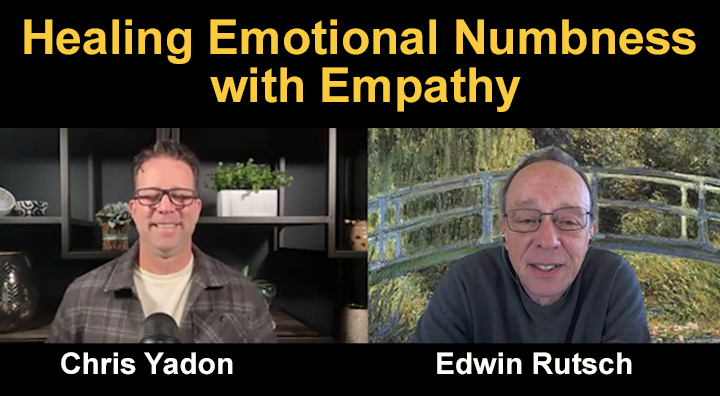
Hi everyone. I'm Edwin Rutsch, director of the empathy Center, and I'm really
pleased here to be with Chris yaden. And Chris wrote a sub stack article
entitled empathy and emotional numbing. Don't get along three concepts to help
fill help us fill the gap. And so we wanted to talk about that article. Really
excited to talk about that. And from what I saw, Chris, you help leaders and
teams and communities break free of emotional numbness and rediscover the
connection that feels high performance, healthy relationships and personal
well being from your LinkedIn page, all right, and your Managing Director of
sapria is that
Unknown Speaker 0:51
that's correct.
Edwin Rutsch 0:53
Thank you. Do you want to say more about that?
Speaker 1 0:57
Yeah, happy to so you know, it's really interesting. My journey with emotional
numbing started as a very personal journey. So when you read my LinkedIn and
talk about Supriya, that pulls in more the professional side of my work.
Supriya is an organization that liberates individuals and society from child
sexual abuse and its lasting impacts. I'm not a survivor of child sexual abuse
myself, but as I came through my personal journey of emotional numbing and
learning how to fill again in our our fairly disconnected world, when I
started to work with survivors of child sexual abuse, I noticed something
alarmingly similar, and that was we were both experts at emotional numbing,
and that's not an expertise you want to claim, but it's one that was certainly
the case.
Emotional
numbing happens to be one of the most common symptoms that survivors of child
sexual abuse experience. So what was deeply personal then became professional,
and it the best part of it is it gave me words as I developed my professional
competency in supporting survivors of sexual abuse, it gave me the words to
describe and define what I had been experiencing, and frankly, what many of us
have experienced with emotional numbing.
So those
that's how those two worlds came together, and I spend a lot of my time as the
Managing Director of sapria talking about emotional numbing. Certainly spend a
lot of time also raising awareness about the issue of child sexual abuse and
its relationship with emotional numbing as well.
Edwin Rutsch 2:36
Okay, and then you wrote this article about, I guess, relationship of numbing
and empathy, and that's what my interest is, where, as the director of the
Center for building a culture of empathy, our goal is to create a, you know,
create an empathy movement to make mutual empathy a core cultural value and
and so You had different, you know, thoughts and about empathy.
And
really excited to talk to you about that. And you had three concepts, I think,
here that you wanted, that you address in the article. The first one is
practice empathy, sympathy, so the nature of sympathy. The next one is
practice introception. And that refers to sensing, the process of sensing
things within our bodies. And then the third is to take compassionate action.
So you're
kind of relating empathy and to those, those concepts along with numbing. So
how to maybe start with, how are you defining empathy? Like when you say
empathy, what do you mean by because there's so much confusion. People mean
different things, and sometimes I even know, you know, I've been doing this 15
years, and I don't know what people are really meaning when they talk about
empathy. Yeah.
Speaker 1 4:00
Yeah. So, you know, Edwin, you and people like you are the experts in empathy.
My expertise is in emotional numbing. It just so happens, our two topics
converge. So, you know, as I view empathy, understand the point of view I'm
coming from, and that's those of us who emotionally numb really struggle with
empathy for various reasons, and we'll get into more of that as to why that
happens. But to your question around definition, if I was to give you my
shortest definition of empathy, from my point of view, it's to feel with
someone, as opposed to feeling for someone, to actually feel with them, to
experience, experience with them.
So
there's actual sharing that takes place, if you get into, you know, the the
broader definition, I don't claim any any extra insight here, beyond just what
our dictionary share with. US and and I start the article by by sharing one of
those dictionary definitions which really defines empathy is an action,
specifically an action of understanding, being aware of and being sensitive
and experiencing so that gets back into that feel with and experiencing the
feelings and thoughts of another.
Edwin Rutsch 5:23
Yeah, so I can, oh, sorry, was it more?
Speaker 1 5:25
Well, I was just gonna say it's that last part of the definition, the
dictionary definition, that's troublesome for those of us who emotionally
numb, because if we're having a tough enough time feeling our own feelings and
emotions, how do I experience the feelings and emotions of another and and so
that's that's that connection between emotional
Edwin Rutsch 5:49
numbing and empathy. Okay, so I just gave you a quick summary of how I see,
how I'm defining empathy. So for me, empathy is sort of like we were saying,
it's the sensing into someone else's experience. So I'm listening. I'm here
listening to you. I'm seeing your body language. I'm hearing your words and
the feelings you're talking about, just sort of the wholeness of who you are,
sort of sensing into your experience. I see you nodding your head in
agreement, and I can feel that, okay, he's he sort of agrees with that
definition. So that's the core of it. Is the sensing into someone. Then I
would say there's self empathy, you know, sensing into my own self. And I
think that's what your introception is referring to. And then I add mutual
empathy, which is that we're here together in a relationship. Are we what's
the level of the mutual empathy we have between each other? And usually
empathy is defined in that sort of individualistic terms, like me empathizing
with you.
But I
think what's even more important is what is the level of empathy in the
relationship. And, you know, how do we, how do we increase that? And is it, as
an aside to there's another part I would call is imaginative empathy, which is
a little bit different than sort of this direct empathy that we're talking
about here. It's, you can do sort of role playing, and sometimes the academics
call it cognitive empathy, which I think is a terrible term, because it's, I
think it's more of an imaginative part. So I kind of have that as a separate
sort of definition. And then we also define it within the concept of an
empathy circle. Which are you familiar with active listening? I imagine, yeah,
so we do a small group of like four people in a circle, and we do mutual
active listening. When person speaks, they speak to someone, that person
reflects back until they feel heard.
A speaker
feels heard, then the listener becomes a speaker, and they speak to someone
else, and they get reflected back, and it goes in that process, you know, for
whatever time is allotted, an hour, hour and a half, two hours, and so that
sort of creates a space for the empathy to happen, and then defining
everything within that context like, you know, when You're listening to
someone, you're sensing into their their experience. You know, an active
listening is a bit of a crutch to sense into. So that's sort of the context,
the framework that you know that I use. I don't know if that makes sense.
Speaker 1 8:35
It does make sense, and it resonates with me in many ways. And as expected,
you being an expert in empathy, I expected a much more robust description, a
much more holistic view of empathy than maybe I could provide. But there's,
you know, there's, there's things that are coming up for me as you talk. So
let me rewind a little bit, even a little bit, into my childhood, and just
share a story and talk about the impacts of numbing and how those impacts can
be counter to empathy and really limit our ability to be empathic with others.
So I grew up next to my grandparents. They were tremendous grandparents.
Grandpa
was a fruit farmer. Think you know, tall, lanky, half moon eyes, you know a
little bit of a crooked smile, well worn. You know, kind of physique that only
comes through some hard earned harvest, through early mornings irrigating the
crops. And I grew up close to him, and I loved spending time with him. I'd
spend as much time with him as I could, jump on his tractor with him, Rumble
through the orchard, sitting on the wheel. So when he was irrigating, I'd make
my little twig boats and float them down the irrigation ditch, kind of
imagining being on that boat, going through that experience. You know,
occasionally we'd stop and pick some, some of the unripe fruit, because that's
what you do when you're in an orchard.
You never
get the ripe fruit. He picked the unripe fruit and just munch. And we didn't
talk a lot, you know, we didn't converse a lot, but we almost didn't need to.
Just being together was enough. I felt safe with my grandpa, and it was an
important contrast for me, because, for various reasons, some of the things in
my own home were unsafe and were challenging, and I had this experience that
was childhood, and now I'm into young adulthood. I was 24 years old, and I'm
at grandpa's funeral, and this is a man I loved. He was my hero, and I'm
sitting there at his funeral, and I wanted to cry. I wanted to feel sad. I
wanted to do what I thought I should, should, quote, unquote, should do to
grieve. And everything was blank. So I'm sitting there all my family, you
know, Tears are coming, right? It was a beloved man, and I'm sitting there and
I'm emotionally flat.
So, you
know, as our brains do, I was like, What is going on? Like, what is wrong? And
I was a newlywed at that time, and my newlywed wife, for the previous two
years, had kind of been nudging me like, Hey, I'm not sure you're feeling
emotions. Talk about a woman that has empathy. That woman is amazing, but she
was, you know, she was, she was kind of prodding me around it. But this is the
first time I stopped and asked myself, like, if something was wrong. And you
know, my brain did. What brains do? You know, I'm like, What's going on with
me? Am I? Am I? Am I a sociopath? Like, no, I'm not a sociopath. Is like,
Well, no, am I an emotionless droid? And, you know, I'm like, No, you know, I
grew up in the Star Wars era.
Our 2d
two was my childhood friend. I'm like, even r2 d2 would cry his grandpa's
funeral. I'm not a droid. What is like? What's going on? And as I reflected a
little more and kind of caught hold of some of those nudges my my wife had
given me. I realized what was happening, and I didn't have the words for it
then, but I do now, and those words are I was numb. I had learned to numb
through the challenges of childhood and trying to be the good boy and avoid
disrupting a family that had a lot of disruptions. I numb my emotions, because
if I numb my emotions, I couldn't make things worse at home. So I didn't
consciously choose to do it.
It's
just what it's just how I dealt with it. And as it goes, with emotional
numbing, what can be protective as a child if you carry it into adulthood,
that protective mechanism of emotional numbing that helps you as a child stay
safe in an unsafe environment actually becomes unhealthy and unhelpful. And
that's where I found myself as a 24 year old, and that's when I first woke up
and started this 26 year journey to learn how to feel emotions again. So
that's the journey I've been on. And as I went through that journey, and
bringing us back to the topic of empathy, there were some really, really
interesting lessons that I learned.
One of
those lessons is when we numb our emotions are particularly disruptive
emotions, those emotions that can be uncomfortable, sadness, anger, you know,
those types of emotions that can be uncomfortable. When we numb those
emotions, not only behaviorally, do we disconnect from those around us, but
biologically, our drivers to connect with other human beings also are limited
because we are spending too much time in our stress responses, and so our
bodies and brains are so focused on dealing what it perceives as the immediate
threat that we can't rest and connect.
So we
disconnect, and when you disconnect, you experience a lot of loneliness, even
in a crowded room. What which is individuals that disconnect from other human
beings? The natural result, or the next step, is feeling a sense of apathy
towards ourselves and towards others.
So you
look at it from through that lens. And, you know, and and in in some ways,
apathy is a very direct antonym to empathy. But even in the broader sense of
empathy, apathy does not get along with empathy, therefore emotional numbing
does not get along with empathy.
So
learning, learning to be empathetic. Those of us that Numb can think through
it cognitively, but empathy is much more than a cognitive exercise. And so the
three tips that I share in those article are very specific to those of us who
know. I mean, they're good advice, I think, for anybody, but they're very
specific things that can help those of us who numb bridge as we're learning to
feel emotions again, bridge between being numb and eventually being able to
practice empathy in a Healthy and helpful relationship.
Edwin Rutsch 15:59
Well, I've certainly felt numbness as well. You know, just especially like if
you're doing a lot of overworking or kind of getting absorbed in work, start
feeling numb and disconnected and but the numbness, it would be maybe, you
know, tying in self empathy into that that you you are aware of the felt
experience of numbness in your body, like, oh, I feeling numb. I can feel my
head being constricted and, and just the full experience of that, and, and I
just wonder about, there's so that is a felt experience, just like joy or any
other felt bodily interception. I think you're saying the felt experience, and
then, like in a in an empathy circle, you can share that with others, and
they'll say,
Okay, I'm
hearing that you're feeling numb. Yeah, right. So you do. You can share the
numbness and have the numbness be heard by someone else or be empathized with.
So you can empathize with your own numbness and have someone else empathize
with your numbness, which seems to be a step in sort of releasing the numbness
that you're sort of airing it, and it kind of can take space out there, and
then you can start working with it, or having it move so
Speaker 1 17:28
you you latched on through your experience, or intuitively, or combo of both
to some really, really important concepts. The first one is every human being
experience as emotional numbing. It's actually protective and productive. It's
a mechanism our body and brains use to protect ourselves. Numbing is not the
problem when it's temporary. The problem is chronic numbing, and the way I
like to describe it to people is this way, short term, temporary or
protective. Numbing is finding a cave to shelter you from a storm.
Chronic
numbing is when we get lost in the cave and forget how to get out long after
the storm has passed. So for those of us who are chronically numb, even those
that temporarily numb, they can they can relate, at least to that experience
of numbing, and even if we have not been chronically numb, we can relate to
others that may be chronically numb, in in that we know what it feels like to
numb.
You
brought up what I describe as hyper productivity when we kind of get so
engaged in our work and work and work and productivity and task lists and to
dos, it's actually a key sign of chronic numbing when we stay in those states
for extended periods of time, because we use those to avoid or distract us
from feeling those disruptive emotions that are so uncomfortable to us to try
and cope with our chaos or environments around us. So you know, being hyper
productive when I got a project to get done this week is very productive,
positive, helpful, healthy.
But if
I'm hyper productive for three years in a row and never stop to slow down and
feel that becomes harmful to my well being. So I love that you brought up
those concepts and and, and they're critical concepts in terms of
understanding one another as human beings when we talk about what it means to
emotionally known.
Edwin Rutsch 19:42
So do you want to talk about the role of empathy that you addressed and maybe
we'll just go through the article?
Speaker 1 19:50
Yeah, I'd be happy to first and foremost. I want to be really clear, empathy
is a beautiful destination for. Those of us that numb, I feel more empathy
today than I ever have in my life, and I love every minute of it. However, for
those of us that numb, that the bridge like I look at that picture behind you
and I see a bridge. The bridge from chronic numbing to empathy is a pretty
long bridge, so we need some helps to get us there. Like, what can we do now,
when we're still struggling with numbing that will help us take steps towards
truly embracing empathy and all its goodness? The first one that I talk about
is practicing sympathy. And, you know, we we've had an amazing movement
happening in society around empathy. A lot of people talk about it. A lot of
people have embraced it.
I
love what all these resources to help with that movement, and we should not
shy away from that movement. We should not teach that empathy is not an
important destination, because it is, but somehow, and I'm not saying this is
your work, but I'm just talking about the broader empathy work, somehow
sympathy has been caught up in the empathy movement, and I've seen it way Too
many times be demonized or minimum, trivialized or minimized as some sort of
lesser experience is actually sympathy is actually a very critical experience,
and in my opinion, I describe it as the appetizer to the main course of
empathy. And so sympathy is something that helps those of us that numb to
bridge to empathy.
And
when I think of sympathy, just back to definitions. If I said empathy is to
feel for somebody or feel with somebody, sympathy is to feel for somebody,
it's like I can cognitively see that you're sad. I don't like to be sad. I
don't want you to be sad. I'm going to feel for you, even if I can't
experience that sadness with you yet. And that's a really, really important
step. It's again, that appetizer that opens the door, because it helps us
start to attune not only to other people's emotions, but to my own emotions,
because cognitively, I'm like he's sad, and I feel for him, and maybe I'm not
feeling sad yet, or, well, maybe I am feeling a little bit of sadness. I don't
know. Maybe there's some right? It just opens those doors for us to bridge to
empathy. So practicing sympathy is is a big one, and let's not demonize
sympathy. It has a role to play. It's an genuine sympathy is really important.
One other
note on sympathy, particularly in our connected world, we see so much tragedy
if you spend any time on social media or watching news cycles, we are
inundated with tragedy, and if I try to practice empathy in every one of those
moments, I am at great risk of fatigue, emotional fatigue, and particularly
those of us that numb, who maybe don't have a huge window of tolerance for
emotions that fatigue can set in quickly, and that has a lot of negative
impacts when we get emotionally fatigued. So being able to practice sympathy
and not absorb all the weight of those day to day tragedies is another really
important reason why? Why we practice sympathy? So I'll pause there before I
get to interception, see if there's anything you want to follow up on the on
the first concept
Edwin Rutsch 23:51
around practice. Yeah, definitely kind of like to explore that concept. So I
think the idea with sympathy and empathy is people. So with empathy, I'd be
sensing into your experience. I'm listening to you. I'm hearing you know what
your your thoughts and feelings, kind of the wholeness of how you are about
about this topic, and with sympathy, it would I've kind of seen it is if you
were in pain, like, I don't sense that you're in pain, so I don't have any
sympathy for you now, in that sense, but sympathy could be like, Oh, poor you
if you were in pain, poor you know, sort of a feeling sorry for you.
Poor
you that you're struggling, and I feel so sorry for you, which is what that
really means, is kind of guess we could go deeper into like there's a sense of
care or or, but I think that the the idea there is, is it becomes about me
feeling sorry for you, versus an empathic approach. Like the empathic approach
would be. Oh, I'm hearing that you're feeling some pain. Tell me more about
that, and then you could share more. I feel pain because my grandfather, you
know, passed away, so I'm hearing, yeah, your grandfather passed and that's
very difficult for you. So with the empathy, I'd be sensing being present,
sensing your experience and staying with you to create a space for you to
share your go deeper into your experience.
And
I know you're saying you're sort of tying into, you know, empathy fatigue or
so forth. I hear that concept, but I don't see that is a fatiguing process. I
find it as an enjoyable, pleasurable, constructive, sort of a process of just
staying present with with someone. And it's actually the the feeling sorry for
you that would cause the fatigue, right? So we have a different and this is
great that we can sort of explore kind of the nature of what's happening. So
it depends on how you mean sympathy. Is that, you know, if it's just a sense
of care, or is it feeling sorry? And the one of the problems with that I hear,
like in with sympathy, is that, because it's becoming about me and my sense of
care. I will try to problem solve.
If I do
problem solve, I'll try to problem solve, to solve my own problem, and not
yours. Whereas with empathy, I'm sensing into your experience, I'm learning
more and more about the nature, the deeper nature of your problem. So that, if
we come to a point where you say, Well, yeah, do you have any solutions? That
I can be more specific in, you know, offering a solution, and a lot of times
you get, you know, people just superficially hear your problem, they try to
give you a solution, which is very annoying I find. So that's sort of my one,
yeah, that's sort of the yeah one aspect of the but we, and I'll bring it back
into the empathy circle.
So in the
empathy circle you would be sharing, and this is more the holistic aspect, you
would be sharing your pain, and usually, sympathy is related to someone's pain
and suffering, not the full spectrum of joy. And like, if you're having fun
and feeling joyful, like there's not a lot of sympathy, and not, you know,
feeling sorry for you, it's more related to that aspect of of the suffering.
So with the empathy circle, I listen to you. I'm staying present to you. I'm
sensing into your experience, until you feel heard.
You know
your time is up, for example, but then it's my turn to speak, and then I would
say to you, and I could so sympathy, the first part of sympathy is empathy,
right? Because you have to even sense that the person is suffering, and then
you bring up a secondary feeling of, you know, feeling sorry for them, or so
forth, or feeling care. And then with the empathy circle, you have space to
share your your sympathies.
Say, Oh,
I feel so sorry for what you're going through. And, you know, I do that
plenty. Say that to people, and then you reflect back, well, I'm hearing you
feel sorry for my experience, so my sympathy is met with your empathy, of
sensing into my sympathy. So that's kind of a longer term, longer deeper, you
know, sort of dive into that. So there is that sort of problem, not problem,
that disagreement. We always say sympathy and empathy in the community. And I
have heard, you know, criticisms from different, you know, people. I think
that that's part of one of the criticisms. Yeah, yeah.
Speaker 1 29:01
There's some tension there, right? And the way I think of the two is less
binary, meaning one or the other, and more progressive. You know, I described
it as a bridge. I described it as the appetizer to the main course. It's, it's
part of the same mill. So to me, sympathy is progressive towards empathy. And
certainly you know that proclivity to go into fix it mode, as I like to
describe it, is less likely to happen. And I don't know that I know enough to
say will never happen, but I'll say less likely to happen through empathy than
sympathy. Sympathy doesn't require us to go into fix it mode.
Genuine
sympathy can just be a sympathetic acknowledgement response without having. To
fix anything. The Selfish aspect you talked about, I think, is really
relevant, though, and it's one of the struggles I had in my numbing journey as
I tried to fill again, is as I started to feel emotions sometimes. Well, let
me just, let me just share a story. I think the story matters. I had some dear
friends, I shouldn't say, had I have some dear friends? This was almost 20
years ago, so pretty, pretty early in my journey, and we were close.
We were
close enough you would describe our relationship with like me to their kids as
kind of an uncle my wife to their kids and Aunt relationship, so not quite,
you know, immediate family. It was closer than that. One of those kids, we
have kind of a babysitting collective. We trade babysitting with them and a
few other couples, one of those kids in that babysitting group, as all the
kids did, we got close to and one of the and so their daughter, when she was
two, she experienced health crisis and had a brain tumor. And so they're up at
the hospital, and they're trying to figure out what's going on. And we get, we
get informed that they're up there. It's the type of relationship where it
would have made sense for us to go up and be there with them, right to
experience and be there to support them.
They
would have wanted it. We had the type of friendship where that was
appropriate. I was so young and young, not in age, but young and mature,
emotional maturity, in experiencing my own feelings. I was overwhelmed with
the news that I received. So this is where that selfish part comes in. And I
was so overwhelmed with it, I didn't feel like I could hold their grief, that
I was already feeling overwhelmed being 40 minutes away through a telephone
line. What would it be like when I saw them, when I sat with them?
Could I
hold that? And so my brain did all sorts of mental gymnastics to find excuses
for why I shouldn't go. And as I went through that, I made up some excuses and
convinced my wife, Christy that we shouldn't go. We should give them space
that other family there and I lived with that regret for a long, long time,
but I had to eventually, in the spirit of self compassion or self empathy,
allow myself a little bit of space. My I go back to that tolerance when you're
first learning to feel emotions again when you've been chronically numbing the
experience you described as someone that you know.
I
don't know you well enough to know this, but I'm just going to make an
assumption, you have a large tolerance to fill with others, to empathize with
others. For those of us that have been chronically numbing, that tolerance is
quite small, and you have to pace yourself, you have to set boundaries through
that process, or you will get emotionally overwhelmed. And is when you get
emotionally overwhelmed, you're likely to return to the very behaviors that
got you in trouble in the first place, with emotional numbing and thwart your
progress. But even in even in some cases, and I see this in our work with
survivors of child sexual abuse, our Thera, our therapists, our case managers,
our team that works with these survivors of child sexual abuse every day have
some of the largest tolerances for emotion of any human beings on earth, and
their tolerance to empathize with others is amazing.
But
even them, if they don't, if they're not careful in doing their own self care,
in being able to evaluate their own emotional tolerance. Can do and have and
will experience significant emotional fatigue. It's often referred to in our
space as compassion. Fatigue is the term that is most common. So whether your
tolerance is really broad or really narrow. Emotional fatigue matters, and our
ability to sense where we're at as it relates to that level of tolerance is
really important. So if my tolerance level is like I'm I'm right at the edge,
practicing sympathy. Is a really good alternative to sitting someone in an
empathic response.
So
that's that's how I would say it applies specifically to the world of numbing,
and why I want us to embrace sympathy as a companion to empathy, not as an
either or we don't. We don't practice empathy or sympathy. Sympathy is a
necessary companion in my from my perspective to empathy, and specifically for
those of us who numb, or have numbed, is a really critical bridge that, again,
that appetizer to that main course,
Edwin Rutsch 35:41
yeah, I'm really appreciating your nuanced and articulate, you know,
exploration of this topic. So I really appreciate that, the with the the story
of, you know, you not going to visit that family. I tend. I put this into the
empathy circle sort of process. So it's like you were concerned that, if you
went and empathized, listened to, you know, the to your friends, and that
their grief, that you would feel overwhelmed, and that you would not, you
know, be able to deal with it. And I imagine you just felt you'd fall apart.
It'd be too painful for yourself. So in that case, the empathy circle, it
would be, if we're using that as a structure, is you needed to be heard and
understood by someone else.
I don't
know if you mentioned it to your wife. It's not like you just made up stories,
you know, to kind of hide what your real experience was. You could have said
to your wife, oh, I'm feeling so overwhelmed. You could have just shared
everything you just shared, and she would have listened and empathized with
you, and that would probably have been sort of a supportive healing process to
help you deal with all those feelings and and that's where you know being
heard by other people kind of helps support that, so instead of you kind of
hiding those feelings.
So yeah,
I don't know if you think about that, yeah, that would have been an empathic
approach. And I just want to be clear that you're you're concerned about going
and falling apart. That's not that falling apart was an empathy that would
have been a block. In fact, it was a block because you were blocked from
actually going and creating empathic support, presence with with your friends.
Speaker 1 37:40
You nailed it. Edwin, you nailed it. You nailed Exactly. So I did have that
conversation with my wife 15 years later, and she was completely
compassionate, empathetic, all the good things, but I lived with that regret
for many years, and, frankly, struggled with selfishness. To me is, you know,
is, is a big no no. And I left. I lived with the regret of what I viewed at
the time as a very selfish response for many, many years, and it was very, you
know, again, it shouldn't have never been about me.
Some of
my closest friends were losing their daughter, and she did pass away. It was
horrific, but my emotional immaturity made it about me, and I had to reconcile
in myself with that selfishness, or as I've learned to describe it, instead of
selfishness, my emotional immaturity, and I'm grateful that I did, and not
only dealt with that regret, but also did the work today that I can stand in
front of you and anybody else, I won't say my journey's done, because those
journey, these journeys don't end. But so much healthier, so much more
emotionally mature than I was at that time.
Edwin Rutsch 39:04
Well, that's what we're trying to create, is a culture that supports, you
know, that supports everyone in that empathic space and mindset. So, yeah, so
I'm, I'm not sure, still not clear on, on the sympathy, the sympathy part of
it, like, like, there's a sense of care.
Like, I
find that when we are empathic with people, we listen, especially in an
empathy circle, we listen to each other, that that's sort of like a first
step, that it and that care kind of grows out of it, like I know you will
listen to me, you know you you listen to me and that, and I'll be heard, and
I'll listen to you, and you feel heard. So a sense, as we understand each
other more deeply, I find that a sense of care sort of emerges. Is, and that
the empathy itself kind of embodies a sense of care, so that so the empath, so
this other feelings like care can sort of emerge out of out of empathy. But I
guess if you care about humanity, then you're more willing to go listen to
people more deeply. So yeah,
Speaker 1 40:22
you know, and I don't know that I'll be able to bridge these two concepts,
because, again, to me, they're so progressive, it's hard for me to delineate
where sympathy stops and empathy starts. But going back to kind of how I view
the two concepts in my most simple definitions, empathy is filled with
sympathy is feel for so when I think or talk about sympathy in the way I
present an article, it's Hey, I cognitively can look at a human being that's
suffering and going that that's not good.
They must
be hurting, that must feel sad without me actually feeling sad, because if my
emotions are numb, I may not feel the emotion of sadness with them, but I can
cognitively say that's not okay, and that's where sympathy, that sympathetic
response of at least acknowledging Another human suffering without taking or
feeling that suffering with them, or even, I would say, even being with them
in their suffering, still has value and still gives that other human being
space. It may not be the same amount of space or the same size of space I can
give if I sit with them in their pain, but it still gives them space and and
gives them room as a to be seen as a human being, to have dignity as a human
being, for me, to not objectify them. So that's, that's how I I think about
these two concepts.
Edwin Rutsch 42:18
Okay, so it's like the numbing is kind of the worst situation state, and then
at least we have sympathy. You're still in some sense of connection, and you
have a felt experience that's not numb within yourself. So you see that is a
Yeah,
Speaker 1 42:34
even with because even with numbing, just to kind of drill into your point,
the way I describe numbing. It's also not binary. I describe it as a box of
crayons. So imagine a box of all red crayons, and on one side of the box is
the palest red, and on the other side of the box is the deepest red. It's a
spectrum. It's a range. Emotions are very similar for those of us as numb,
that numb. It's not like so back to that example of seeing someone that's sad.
It's not that maybe I have an inkling of sadness that I feel I'm like a really
pale red when it comes to sadness, but my ability to empathize with that
individual, if I can feel a deeper red or a deeper sadness, it expands my
ability to really be empathic with that individual the deeper that is in that
range.
So so
it's not like numbings on or off, and it's 100% cognitive, but when we're
pretty pale red, when we're pretty numb, our sympathy may be, you know,
arbitrarily, I'll throw out these numbers, 90% cognitive, 10% emotional,
whereas when, when we're able to feel more, you know, we have a more equal
balance between the cognitive and emotional experience and empathically
supporting being with giving space for that, that human being.
Edwin Rutsch 44:08
Yeah, I'm glad you brought that up. Is that That's why I wanted to talk to
you. But you brought up a lot of concepts that I kind of have disagreements
with, and one of them is this cognitive, affective concept in, you know, like
a lot of my work, is really based on the work Carl Rogers, who, you know, just
he did empathic listening, active listening, with his patients.
And he
just sort of described the landscape, you know, the benefits of it, and how
the process worked. And then it seems like other, you know, I don't know the
the cognitive psychologist, they got a hold of it, and they create this binary
of affective and cognitive, yeah, and so for me, when I listen to someone, I'm
not saying, Oh, that person, this is cognitive. This is affective within them.
It.
All kind
of like one and together. I don't even, and I think that whole concept has
been very destructive of cognitive, affective it to me, it doesn't make sense.
And I've even heard that, you know, a lot of the cutting edge of psychology,
they're kind of wanting to, you know, drop that too, because it because
there's sort of a wholeness of the person. So somebody can say, I feel in my
head, that's a felt experience of being in your head, you feel that
experience, or you can feel, I feel in other parts of my body. So it's sort of
a differentiation that I think is not helpful. It's not even accurate. It so
that I don't know how that kind of resonates with you, with the
Speaker 1 45:48
you and I, you and I may disagree a little bit, but probably less than it may
sound. And let me, let me share where, why, why that may be the case.
Researchers, I
Speaker 1 46:09
I'll parse data and distinguish between A, B and C, because of that in any
scientific field, particularly social sciences, there's a proclivity to take
out the nuance, to take out the spectrum, to take out the range we like to
think make things more Binary than they are, and I think that plays a lot,
introduces a lot of challenges with social science, specifically, which is
where these researchers develop these terms.
They use
these terms to define in their research, so that they can distinguish between
a and b, when, in fact, a and b are always a blend. They're not actually two
separate things. When you're talking about human beings, our behaviors, our
interaction. So when, when it goes from researchers to, say, my therapist, my
therapeutic team, they're much more, where were you described? It's like, No,
we're talking about human beings, and there is so much nuance in this. There's
so much blend, you know, we talk about, you know, something like even our
physiology, right, the brain and the body. It's like they're so
interconnected. Why are we distinguishing between one and the other, mental
health and physical health? Sorry, they're the same thing. It's just health
and and so I understand why we get there. I understand where these terms come
from. They do serve a purpose.
They do
have. They, they do they, they do help us advance. But they also come, in my
opinion, with some collateral damage, and that collateral damage can cause a
lot of confusion, can take the nuance out of a very nuanced conversation. So,
you know, in my mind, just like I described the emotion spectrum, and just
like I described with sympathy and empathy, to share the principles and
article, I have to use different terms to make the points. But you know, like
in my mind, and probably I would even say in my heart of hearts, sympathy and
empathy are progressive in nature. They're they. We use different terms, but
you know, what's the real difference? It's actually more progression than the
difference.
Edwin Rutsch 48:26
So, yeah, I agree with that. It's like a rainbow or, yeah, shades, exactly.
And plus, you can have multiple shades within mix, and the combination of
shades is kind of like unlimited. So I mean, I can be listening to you,
empathizing, being present with you. I can feel some sympathy, but I can also
be more present and and, and those levels, I guess, what I look at is, is that
it's my presence, being present with you, or the person I'm listening to or
empathizing with I can have all kinds of even judgments and so forth arise.
But does
it come to a point where it blocks the empathy, you know? And that's, I think
that's it, to realize all those things are going to come up and not be even
judge self, judgmental of the things that are arising. So it's just that, you
know, I get frustrated with the affective, cognitive part, because the
academics have sort of gotten into it. Then everybody kind of copies the
copies the academics and all these articles about it, and it's like the
academics are not. What I loved about Roger's work is he, he had, he was a
practitioner and a scientist, and then so he was kind of mapping out the felt,
the real experience of the empathy. So I guess I just kind of admire that part
versus being totally off in the theoretical that much of the academia is.
And
then they kind of get. Lost in the abstractions, and it loses contact with
what's really, really happening. So and trying to build a movement, you want
to be able to define your terms, and that they're just making it a terrible
mess to define our terms. And then it leads to books like against empathy,
where they're everybody's talking past each other. So it's kind of
frustrating. And I think these dialogs is how we kind of come to shared
understanding, though. Anyway, yeah,
Speaker 1 50:29
and as you're describing Edwin, I'll call it something that I value a lot. I
actually value the tension between the practitioner and the academic. In fact,
we purposely at sapria play out that tension we have our practitioners and we
tend to hire Vic tenured. They've sat knee to knee with 1000s of individuals
dealt with this issue of child sexual abuse over and over. Right? They know
their stuff. They've seen it, they've been there. They've been in the room
with the people. They know the impacts.
Then we
have our education team, whose job it is to comb through all this academic
research and bring to our organization the very best practices around the work
we do to heal from child sexual abuse and prevent it, and then we put those
two groups in a room to help us figure out what our actual programming should
be. And that tension between those academic drivers and that practical
experience for us has proven to develop the very best solutions. So that's
been my experience between, between those tensions.
Edwin Rutsch 51:45
Okay, so if the academia supports, you know, sort of a practicality and offers
insights and so forth, or theoretical things to test, I mean, I'm fine with
that, but so, but let's we kind of running out of time here. So we want to,
we've only done the first topic of I can go a little bit longer too. But
number two is practice interoception. So that's maybe, if you want to cover
what you mean by that.
Speaker 1 52:13
Yeah, interception. So I think most of your listeners may get up. But just in
case, let me just describe how I define it. As if we think of perception as
perceiving the word world around us, we can think of introception as
perceiving the world within us. And so when it comes to emotional numbing and
interception, interception is our ability to notice the physical responses
that come up with our emotions. So when I feel fear, does the hair on the back
of my neck stand up? When I feel anger, does my my heart start racing, blood
start pumping, and my face get flush? Those, those would be introception
capabilities around my emotions. For those of us that numb intraception is
really important for emotional attunement, and I define attunement as the
ability to notice name and respond to our emotions.
And so
noticing our emotions, it's like, am I feeling sad right now? That might be
harder for me to answer than it is to say, Do I feel a pit in my stomach right
now, or am I feeling angry right now? Might be harder for me to answer than am
I feeling flush in my face right now. So again, interception serves as a
bridge to help us be able to attune with our emotions, to notice name and
respond. I'll give you another story. Anger was the emotion I suppress the
most, numb the most, and you know, for for the reasons I described earlier, I
didn't want to disrupt things in my home, and anger would be the most
disruptive emotion as a kid or a teen that could elicit an undesirable
response in my home.
So I
shoved that one pretty deep as such, whether by my own fear or just the
reality of the emotion. It's the one that took longest for me to surface, but
introception was really critical in helping me surface it, and I remember the
very specific moment. So again, I'm on a I've been on a 26 year journey. In
this case, we were in year 20 of that 26 year journey, and prior to that, I
certainly felt anger. But I would describe it as I'm feeling a little
irritated. I'm just a little bugged. I wouldn't acknowledge that. Oh, I'm
feeling anger like that was, you know, I just couldn't acknowledge it. So it's
covid. Things aren't going well for. Any of us, I'm sitting in the car, my
wife and I are trying to do a date night by ourselves, sitting in a in a car
at a park, we'd get gotten some takeout food, you know, you you, you know what
it was like.
And we
started talking about some of the impacts on of covid, on society, on, you
know, our family. And then we talked about some of the impacts it was having
on Supriya, our nonprofit that I worked for. And, you know, we were having a
tough time, as many nonprofits did during that time, and and, and I started to
get flush in the face, and my heart started beating, and it was the first time
in real time that I was I turned to Christie, and I said, I think I'm feeling
angry. And it was funny, because my emotions immediately switched. I was so
excited that I was able to do to acknowledge it in real time that, like, the
anger immediately left.
And I was
like, super pumped. It was like, I've been working on this for so long,
because every time before that I could, I could acknowledge or recognize my
anger by looking back, but I couldn't experience it in real time. And
interception is what helped me do that. My face was getting flush, my heart
was beating, and I noticed that. So it was an extremely valuable skill that,
again, helped me bridge my ability to embrace all of my emotions, you know,
and I'm still working on them all today, but there's no emotion that I know of
that I haven't been able to turn back on at this point in my journey, and
interception has been been a big part of that. So that's, that's the role of
interception as it relates to learning to fill again. Yeah, for
Edwin Rutsch 56:49
me, I would call that self empathy, and it's part of creating our empathic
relationship. The deeper I can sense into my own experience and share, the
deeper the the the empath, the mutuality, or the holistic. I call it holistic
empathy that we can have.
So it
plays a part. For example, I can even if I sense into myself, in talking about
numbness, I really concentrate, you know, like I want to be sure to cover all
the points here that we've talked about, and I keep them in my head, and don't
want to lose them because I'm afraid I'm going to get them back. So I really
hold them tight in my head, and I can feel the constriction, almost like a
numbness within my head from for almost that intellectual what have you kind
of quality. And so just since this is an example of my own self, empathy,
sensing into and I can kind of release that and see what's under it.
There's
some kind of a fear, anxiety, and there is a practice for that, if you're
familiar with focusing, created by Jean jendlin. I'm not familiar with that
one. So it's a process, you know, Carl Rogers developed the empathic
listening, you know, process, and a lot of the theory about human centered
approach and Gene zenlon was one of his grad students, and he was wondering,
like, what therapy? What? Why does therapy work for some people and it doesn't
for others? So he did a study of the wide range of therapies, and he found it
was the people who spoke from their felt experience in the moment that had the
most growth in in in the therapeutic process. So it's exactly what you're
saying by, by addressing that anger. It's like other things arise and you're
able to, you know, personally, grow. And anyway, they have a whole set of
tools for how you do that connecting to your felt experience. It'd be like a
interoception or self empathy practices. So yeah,
Speaker 1 58:50
I love that. I love that bridge you just made. And I haven't heard that term
used as that bridge, but it makes complete sense to me as you describe it. And
I love that you described your own introception around holding on to those
facts and the fact that you could tie it to potentially, maybe there's a fear
that I'll lose it right? That's it's just, that's just emotional intelligence
at its best.
And for
those of us that numb, that's what we're trying to learn and develop and grow.
Because when we started numbing, which for many of us start in childhood, it's
almost like it stunts, like I had to start over. You know, I don't know what
age I was when I officially started numbing, but let's say it was 14. It's
like I'm starting over again as a an emotional 14 year old, and I have to go
through that maturing and interception helps us do that. I think one other tie
to empathy with interception is the concept of perspective taking you know,
maybe I can't quite identify, oh, I'm feeling sad. They're feeling sad. I'm
feeling sad. Oh, I'm feeling sad with them.
But I can
say, hey, I'm feeling a pain. It in my stomach as I hear them talk about what
they're experiencing. So maybe, maybe a survivor of child sexual abuse is
sharing her story with me, or his story with me, and I feel that pit in my
stomach or or my face gets flushed because I'm feeling some anger towards the
person that harmed him, my ability to recognize those physical sensations
through interception. What that tells me is, well, maybe I'm feeling with them
more than I think I am, even if I can't say, yeah, yeah, you're you know, I
can feel that anger with you, I can say, Oh, well, maybe I am feeling that
right. So interception helps bridge that do what you do and didn't say. Maybe
it's the fear so that notice, part of the notice, name and respond,
interception really helps us attune that notice
Edwin Rutsch 1:01:03
part, just as a note that periodically, your video freezes for a second or
two, and then the audio kind of catches up quickly. So just wanted to make a
note for anyone watching so I can say, for example, it's the it's the the part
of the empathy circle is like sharing what your felt experience is, and have
someone listen and hear that and reflect it back. It creates movement, like
when I shared that, that can that numbness, or, you know, tightness, I could
feel like something came into my heart, a little bit of a anxiety kind of
happened. But as time went on, I could feel in this part of my body, it's like
more space sort of has happened, like the the constriction that I was feeling,
it felt sort of more spacious. And you can feel what parts of the body feel
more spacious.
So that's
just, I think that's, yeah, just the kind of that self empathy, sensing into
and when you share that with someone else, and they reflect back or really
hear you, it there's movement that happens, and it usually the movement is
like, less constriction, less anxiety, And it's you move more towards a
positive you know, feelings is what I what I find. So I love it. Yeah, so, or
if you have time for just going into taking compassionate action, and, yeah,
and what do you mean by that?
Speaker 1 1:02:35
So, again, without trying to distinguish too much between sympathy and
empathy. I'm going, I'm going to and saying that compassionate action, we can
take Compassion Action on sympathetic feelings, on empathetic feelings. And
this back to our earlier conversation, where we were talking about fix it.
This is less about fixing it so that we don't have to deal with the
discomfort. This is more about taking action where we relieve or ease or
lessen the pain and suffering of others. And that, to me, is where compassion
really lives, is easing that pain and suffering of others. And so from my
perspective, the the hallmarks of compassionate action can be summed up in
three terms, show up, serve and listen. So you've talked a lot about active
listening. This is where active listening fills, fills, fits. In my mind is
active.
Listening
is an act of compassion. It's something we learn how to do, we practice and
then we do because that other human being is worth their dignity, worth our
time, worth our effort, worth our emotions, worth our mental capabilities. And
so for me, that active that that active listening is is a really, really
important part of compassion. Act action, the show up and serve side show up
is the part of empathy where it's like, I'm going to be with you. I don't, I
don't. I'm not going to prescribe what's about to happen, but I'm going to be
with you, I'm going to show up. And it doesn't mean just physically be
present, but it's what, what you've described in spades on this call. It's
like, I'm going to be emotionally present, cognitively present, fignate,
physically present, all, all of it. I'm going to be with you. I'm going to sit
in this with you, whatever this is.
So that's
the show up. The serve part is that relieving the suffering. And this is
where, you know, we have to be careful, because. Because, and we see this a
lot with our survivors of child sexual abuse, if we interpret service to be
the fix it mentality, and we make it about us, and I want to fix it so I feel
good about myself because I'm helping you, or I want to fix it so your nervous
system regulates, so I don't have to deal with an unregulated nervous that's
not, that's not service in, in the way I'm describing it here, service in the
way I'm describing it here is on their terms.
One of
the biggest things with survivors of child sexual abuse is their power was
taken away from them when they were abused, and so it's really important, and
we practice actively when we serve them, when we work to relieve pain and
suffering, it's on their terms, on their turf, when they when they're ready
for it, when they want it.
So
there's a lot of questions, a lot of checking to see if whatever we're doing
to take action, that compassionate action, to serve that individual, is within
their agency, is within their desires of what they want and feel like they
need at the time. So those are the three things that are big for me, on the
Compassion Action and and they full they show up on the full spectrum. Maybe
I'm at the very infancy of sympathy, or the the very maturity of empathy, or
somewhere in between, wherever it is compassionate action can take place.
Edwin Rutsch 1:06:35
So in terms of the definitions and terminology, I get frustrated with the
compassion community, because they create this model of sympathy, empathy and
compassion is, is that action, taking action, and it's different than kind of
what I experience, and so I have in our in our model we we call It empathic
action. So it's very much just kind of what you're talking about, where you're
not like imposing something on someone else, but there's sort of a
negotiation, a mutually empathic dialog, about what our actions will be, and
you see it really clearly in conflict mediation. So if we have different
disputants, and then we do like an empathy circle with them, and they're
talking and kind of sharing their experiences, and they're listening to each
other.
There
comes a point where they understand why the other person did what they did,
and they understand each other. There's sort of that mutual understanding. And
then the question is, is, what do we do going forward? And then there has to,
there's a negotiation in terms of, well, how about we do this? The other
person says, No, that doesn't work for me. How about we do this? And then it
kind of goes back and forth with this discussion until there's sort of an
agreed upon action. It's not like an imposing like you're talking about people
who had been abused. You don't want to be telling them what to do. It's like,
well, maybe we try this. Well, that doesn't work, but how about we? But it's a
mutually empathic dialog, and the action that comes out of it is sort of an
empathic based action versus a one sided do what I tell you to do, or or here,
here's, here's my suggestions, and there's no sort of kind of mutual
understanding and agreement around that.
So it's
interesting how, at the core, I find that there's a lot of the the
experiences, the phenomenon, are the same phenomenon. We're using different
terminology. And that was one reason I'd want to talk to you, because there's
you brought up a lot of sort of concepts that I kind of pull out my hair. It's
like, No, this is what it means. But it's really through through dialogs that
we come to mutual understanding. So I'm really appreciative of you taking the
time to, you know, chat, chat about this, and, you know, share everything so
articulately. So yeah, it's well,
Speaker 1 1:09:08
happy to really grateful to spend time with you. And there is no question. We
are limited by our language. We're limited by our definitions, and
particularly in the social space when we're dealing with human beings, and the
nuance and complexities that comes with those of us who are human beings,
having some space for different interpretations, different descriptions,
different terms, is really important, And that's why getting together and
dialoguing like this helps us suss out some of those nuances. My last or final
thought on the compassionate action piece and why it's so valuable for those
of us that numb is, as we mentioned earlier in our visit. Uh, hyper
productivity.
To Do
lists are a big deal for people that numb. We're we're really good at it.
We're some of the most productive people in this world. We get a lot done. So
it's easy for us to wrap our heads around action. We just have to to help us
bridge to empathy, add that compassionate word to check ourselves, to make
sure our actions aren't 100% selflessly driven or motivated to appease or fawn
or reduce emotions of others. And so that's why that word compassionate action
has to go together, is that's, that's how we check ourselves and make sure our
actions that we're so being needs and wants.
Edwin Rutsch 1:10:54
Yeah, it's that that you bring caroms, you can, you can be very productive,
but eventually you burn out, and then you're not. It's like not being
productive, yeah, after that so well. Thanks so much for the discussion. And
to be continued, we'll, we'll post this. Thank you. And to be continued, yeah,
it's been a pleasure.
Unknown Speaker 1:11:19
Thanks for having me. Edwin, yeah, real
Edwin Rutsch 1:11:20
pleasure here, too. All right, take care, bye, bye, bye.