|



|
|
Culture of Empathy Builder: Jake Via
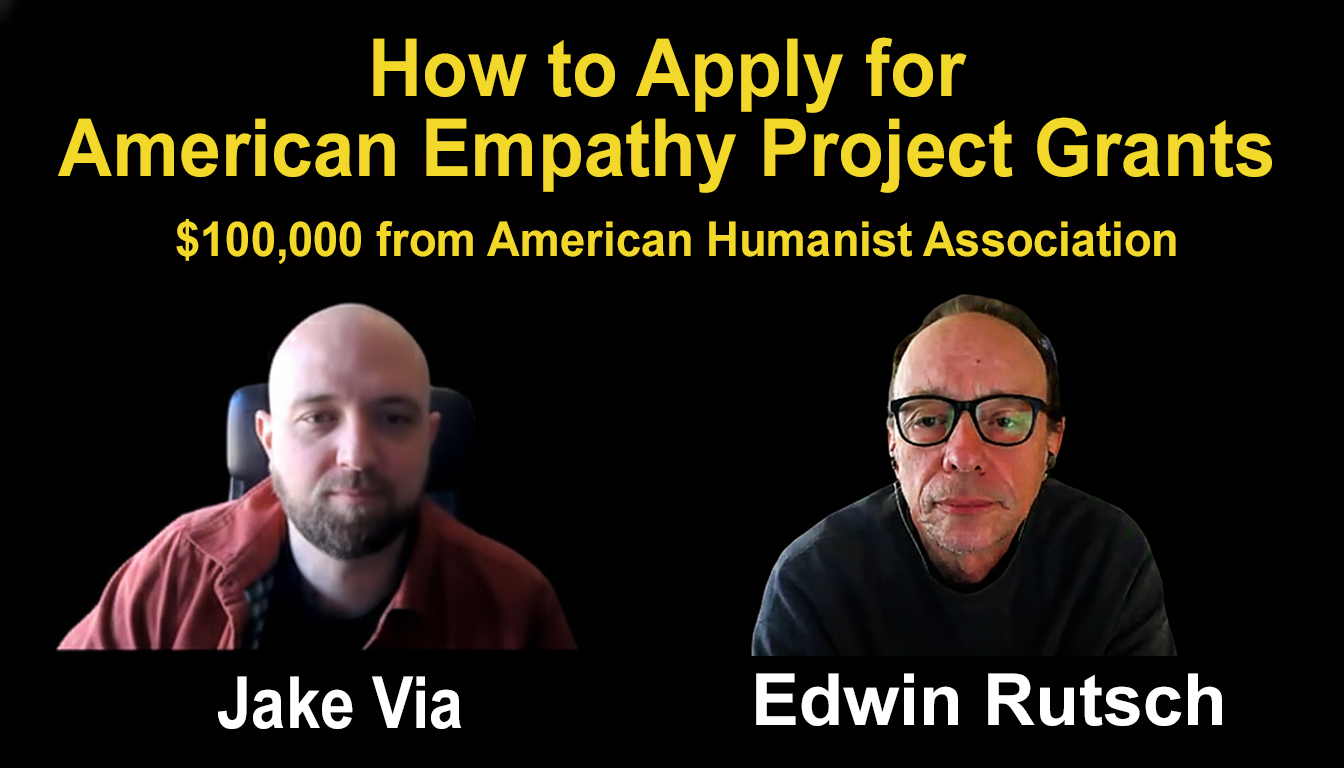
How to Apply for the American Empathy Project Grants ($100K) from the American Humanist Association
SUMMARY
Edwin Rutsch, director of the Empathy Center, and Jake Via, organizing director of the American Humanist Association, discuss the American Empathy Project, which aims to distribute $100,000 in grants for empathy-building projects. The project, launched with support from YouTube creators, has received over 200 grant applications and 1,000 expressions of interest. The initiative emphasizes empathy as a core American value, countering criticisms from figures like Elon Musk. The project includes various service projects focused on food, care, affirmation, conservation, welcoming, and respect, with a National Day of Service on May 2, 2026.
OutlineAmerican Empathy Project Overview
Inspiration and Evolution of the Project
Addressing Criticisms and Defining Empathy
The Role of Empathy in Humanist Values
Types of Empathy Projects and Their Impact
Social and Political Bridging
The Impact of Covid-19 on Empathy
Empathy Practices and Training
Future of the American Empathy Project
TRANSCRIPTS
Edwin Rutsch 00:02 Hi, I'm Edwin Rutsch, the director of the empathy Center, and today I'm very pleased to be here with Jake via and Jake is a organizing director of the American Humanist Association, and they're hosting the American empathy project. And this project is going to be giving out $100,000 in grants for empathy building projects. And so there's going to be $101,000 grants, actually. And you can see more about this at American empathy project.org and thanks for joining me, Jake. And can you tell me about the American empathy project?
Jake Via 00:43 Yeah, thanks so much for having me. Edwin, I appreciate it, and thanks for everything you do to promote empathy. It's it's been really great learning about your projects and your orgs. So the American empathy project was born out of this idea that empathy is what binds us. Empathy is what brings us together. It's a core American value. But we've had people like Elon Musk calling empathy suicidal. We've had other leaders on on the radical religious right calling empathy toxic and calling empathy a sin when really empathy is a biological evolutionary trait that's made humanity kind of successful as we've been as a species, it's the cooperation that brings us together, and it's the thing that keeps us all moving forward in a positive way. So every year, we typically do a grant project program around supporting our local communities to give back, and this year we wanted to make it really intentionally focused on empathy as a positive virtue of humanity. You know, humanists believe that science tells us what real, and empathy tells us what's right, and when we treat each other with empathy and compassion, we create a better tomorrow. So for the American empathy project, we you know, typically, we've only had $10,000 budgeted for grant projects, but this year, we really wanted to pour some some more fuel on the fire, and asked our donor base to step up a little bit and and so we're going to be giving away $100,000 to 100 different projects around the country. We hope to sponsor more than that, if we can convince our donors to continue to helping us out. And we launched last week. It's been really incredible. We we launched with the help of a bunch of YouTube creators and influencers. We're close to 200 applications already on the grants, which has been incredible. We've had over 1000 people already sign up the interest form for finding out more information about projects once those start to get posted, and it's just been a really incredible turnout people, people respond really well. People are desperate for more empathy and in more kindness, I think, from the National kind of conversation. So have you been seeing that same thing in your work?
Edwin Rutsch 03:00 Yeah, definitely the, you know, there's been a lot of criticisms of empathy, as you were saying recently, and I think it may put a little bit of a damper on it, but then there's a lot of reaction too, and I'm seeing perhaps this project that you're doing is a reaction to the criticisms of empathy. I was wondering about how the project came about, because I was just looking on your website, I saw Jelani Cobb receive the humanist of the Year Award, and he did a in the video. You can see his video. It's Jelani Cobb on democracy, empathy and justice, and he really talked about the importance of empathy. And I was wondering if was that an inspiration for the project, or how did the project really come about?
Jake Via 03:47 Yeah, it, you know, what it might, it might have been. We started talking about this project right around that point in time. Our original name for this project was going to be, make empathy great again. And we thought that, you know, maybe that name would have worked really great in 2017 but, you know, a lot of us are really tired of of the rhetoric and the comparison. And so we, you know, 2026 is the America 250 and and so the American empathy project made more senses to us as a name, but we've been thinking about this project since around that time, so jelani's presentation might have had something to do with it. For humanists, for a long time, we've talked about compassion. That's kind of one of our leading values. And while I think compassion is fantastic for me on a personal level, empathy has always been the more the more critical component. So I worked at the YMCA for a really long time. I worked at an organization called Play, works for a number of years, and when we play together, the same part of our brain that's associated with empathy lights up play literally builds more empathetic experiences and relationships. And so empathy is just something that I've been talking about for most of my adult life. Yeah, and it's, I don't know, to me, it's the most important kind of way that I show up in my life. And the same is true for most of our leadership staff here as well. While we love compassion as a core value of humanism, for us, empathy is more of a I guess it's maybe more of a verb, right? More of a something that you put into motion. And so that's kind of where it was born out of for us, is this idea of, let's push back on the the the toxic, suicidal rhetoric, and let's put our money where our mouth is and put our hands to work and get people activated around it. I'm curious, though, as you do this work all the time, what is your response to people when they talk about suicidal empathy or toxic empathy? Because we posted about this on we posted about the American empathy project on Reddit last week, and it got several awards. It got 1000s of upvotes in subreddits like the empathy subreddit and the kindness subreddit, but we also had a lot of comments that just said toxic or just said suicidal empathy. What is your response to people when they come at us like that?
Edwin Rutsch 06:11 About empathy? Yeah, maybe I'll step back a little bit and just mention that I grew up at a Christian evangelical family kind of took that seriously. But after years of traveling and and just just life, I guess I that sort of dropped, you know, behind, and I think I have more association with sort of the humanist, sort of values, and that's why, you know, I when I learned about empathy. And this is, like, over 15 years ago. I said, this is core to human well being. This this one value and so and even, you know, Jelani Cobb, he meant she said empathy is enough. It's at the center and core of morality. So I really think it is the core of the humanist worldview. So just want to kind of mention that sort of in the framing. So I've been working, you know, on this, this topic, you know, reading all the papers, all the articles, you know, writing about it, interviewing, probably interviewed 400 over 400 people on the topic. So I've been totally immersed in this you know, topic, and you know, our goal at the empathy center is to make mutual empathy a core cultural value. And so what you know? So your question about, How do we, you know, respond to the criticisms of empathy? And I think that to a large part, it's that we're talking about different experiences, different phenomenon. So it's the definition problem of, what do we mean by empathy? I think is sort of a block to the progression of the empathy. You know, movement really. And we've done an empathy tent, where we take a tent out to public spaces and offer listening to, you know, people the public. And also we've taken it out to demonstrations where the political right and political left are kind of battling it out, and we offer listening to both sides. And then we bring the sides together until we call an empathy circle. And they actually, you know, are after taking part in an empathy circle, they're actually hugging each other at the end. So I think a lot of it is that we're talking about different things. You know, people are kind of confusing empathy with sympathy, you know, feeling sorry for people. And there's also an individualistic this definition of empathy, where you're individually empathic towards other people. And what I look at is what I call holistic empathy, or mutual empathy, that it's really about a mutually empathic relationship. And I found that, you know, with the people on the right, if they understand what we're talking about. It's just about listening to each other. They're actually very supportive, but we're talking past each other. And what I've done when you see criticisms like that, is say, great, you're you have comments about this, let's have an empathy circle to talk about it. And so we and so I would invite you, and I'd be glad to help with that, that if you want to hold empathy circles with people who are critical of it, we show them how to do, you know, mutual active listening, and then we actually talk about it. And I found that, you know, I've converted people who are critical of empathy, and once they understand what we really mean by empathy, they're actually very supportive of it. Yeah, yeah.
Jake Via 09:44 Love that. I think I was also raised evangelical and and one of the stories that I think about all the time in terms of MP is the Good Samaritan story, right? Of the the so many high end falutin kind of religion. People walk past this person who needed help, and then somebody who, you know, the religious people a day looked down upon, was the one who stopped and helped the person on the side of the road. And I think so much of that is relevant to today as well, like we see a world of high and mighty people telling us not to help the people that are stuck on the side of the road, billionaires who are calling empathy suicidal and toxic, and it's everyday people like us that are stopping and saying, No, like this. This is I want to understand how you ended up here, and I want to understand your position, and I want to understand how I can help you kind of move forward, and how we can move forward together. And I think that's kind of what we're trying to accomplish with the American empathy project is, you know, from the secular side of things, from the humanist side of things, a lot of humanists identify as atheists as well. And there's a, I think there's a undercurrent of fear or an undercurrent of of negativity associated with the term atheist. Still in America. There wasn't that long ago that the Pew Research found that atheists were the most were the least trusted subgroup in America, and and then right behind that was like Mormons and Muslims, and I think over the last 20 years, atheist is a term, has kind of come a long way, but for most of us who are humanists, we're humanists first, and kind of atheism is just something that's there. But a lot of us live with this idea that people are stopped at the gate because of us being, you know, of me identifying as an atheist or whatever so. And then, once you start to have a conversation, once you start to use active listening, and once you start to do service together, you start to see that things that we are aligned on, which is our values and our ideas about what a healthy society looks like and a healthy community look like, are actually really in line with each other and are really the same across differences, once you kind of remove the supernatural discussion, maybe from the conversation, but we never get to that place if we don't have a conversation, if we don't have empathy, and if we don't get in the dirt to work together. And so the American empathy project is really about that, like none of our service projects are going to be given to a closed ecosystem. We want all of the money that's going to these projects to be an open invitation to anyone in the community to participate in the project, and so that we can kind of create these kind of cross cultural differences and opportunities for people to have a conversation with someone that they might not usually get to interact with. Because that's what's going to make America's next 250 years better than the last 250s is creating bridges, like your backdrop there to span the divides that you know, and so much of the divides that separate us are just manufactured like they're not real, like when we actually sit down and talk to each other, Like you experience in the empathy circles, like we have way more in common, but you know, the our news cycles have been so hyper, you know, critical of each other, that we don't know how to have real conversations anymore. We don't know how to not be afraid of our neighbors. And that's not the America I want to live in. So that's really what the American empathy project is all about, is bringing those conversations back to the communities that we live in.
Edwin Rutsch 13:30 And the nature of the grants I saw that you had, have a list of the types of projects. You have some sort of toolkits for topics, food over cruelty, care over cruelty, affirmation, welcoming, conservation and respect, is that, is it more of a service? You're looking at the grants for service projects or sort of, what's the what's the nature of the grants?
Jake Via 13:56 Yeah, so we focused on May 2 as the National Day of Service that we're trying to push for. So we'd love for all of the grants that we give away that day to all happen on May 2. All happen on that same day that, you know, just just like any mobilization, it helps to kind of have everything concentrated for, you know, media awareness and things like that. So the we put together a series of projects that are recommendations for people. We tried to make it as easy as possible for people who have maybe never done a service project before to pick up a project guide and just say, Okay, this makes sense to me. I feel like I can do this. We'd love to find people who maybe haven't ever taken this on before, but are are frustrated and are tired of feeling like they're afraid of their neighbors, or like, you know, I think a lot of people in America right now feel helpless and a little bit hopeless, and picking up a shovel or picking up some food baskets can can do a lot to help us feel like, okay, I can parts of. Participate in democracy. I can participate in civic engagement. I just got to do it. And so, yeah, we put together project guides on food over cruelty, which is, how do we, you know, work with local food pantries or little free pantries in order to make food healthy, food available in a stress free way. We put together some project guide and conservation. How do we fight back on on litter and plastic production and keep our neighborhoods and our communities clean together? We put over an affirmation over cruelty project Guide, which is really about a lot of LGBTQ teens. Don't have access to gender affirming clothing, and that's a great project to work with in a local Pride Center or local LGBTQ Center. Care over cruelty is is a medical debt jubilee. So this one's pretty exciting. You can buy off medical debt at 100x So $1,000 can pay off $100,000 in medical debt, which is, if that doesn't tell you how broken our healthcare system is, I don't think any anything will, but we'd love to see some of these projects go to canceling medical debt for people and helping people feel some sense of financial stability from that, and then welcoming over cruelty, is another project guide that we put together, another event that we'd love to see, that one's really about. How do we create immigrant friendly communities and immigrant friendly neighborhoods where nobody's afraid of their neighbors? Everybody deserves to live with self determination and dignity and not be afraid of the people who live around them, whether that's fear of not understanding an immigrant's background, or as an immigrant, being afraid of your neighbors, maybe not understanding where you came from or why you're there, and then respect over cruelty. We have a lot of senior citizens in our country that are suffering the same loneliness, loneliness epidemic that that younger folks are. And so how are we creating kind of a senior Joy drive to kind of bring folks out, and then we also welcome anybody who wants to submit their own project. We've we've already seen several of those that are maybe not happening on May 2, but are already scheduled to happen around that same time period. And so we're happy to evaluate those as well and see if we can support some of the projects that that are already doing good and just needed a little infusion of some extra cash and maybe some extra promotion. So that's what we're here for.
Edwin Rutsch 17:40 And how about, like, social and political bridging type of work. I, I do notice that you in the, you know, food over cruelty, for example, you say while they so there's a bit of a they, is the US and, yeah, and them. So it could be, I could imagine some people would see, this is sort of a us and them, sort of a framing, and which is a little bit different than bridging. If you wanting to do, you know, social, political bridging, it's like, okay, you know, bring, bring whoever you are to the table. And, let's, you know, talk about it.
Jake Via 18:15 Yeah, I, I won't say that there's some people that we don't want to work with, but if there's people out there that think empathy is suicidal and empathy is toxic, and they've already written it off, I don't see them showing up. And so when, when we use the word them, it's mostly the the people that are currently attacking our neighbors and our loved ones, the people that are denying LGBTQ rights, the people that are denying women's choice, the people that are terrorizing immigrants. So, you know, some people, one of the comments on Reddit last week was that us using the word fight and the word empathy in the same language was a bit ironic, but I think we, we fight for, you know, we fight against hunger, we fight against we fight for peace. And I think fighting for empathy is kind of the same thing where there are people attacking this value, there are people attacking the the idea of loving your neighbors and and somebody needs to kind of push back on that and say, No, that's there is a right way to live. And it's it's with empathy, it's with care. It's with compassion, it's with an open heart. I think selfishness has become so pervasive in our language as as a country, that we've become so insular in our own little houses, in our own little neighborhoods and our own little spaces, that we've forgotten how important opening ourselves up to to strangers and opening ourselves up to neighbors is, you know, I think you and I both remember cycling around our neighborhoods as kids or to play. A and a lot of that doesn't happen anymore because we've become so afraid of the people on our own streets where having a block party can change that, right? Having a community garage sale together, where, you know, everybody from the neighborhood is invited to bring all of their stuff to one yard. That like just creating opportunities for conversation, creating opportunities for community, is really important. So while we do use some they them language in terms of who we're fighting against, I think we're very specifically fighting against people like Elon, who are actively trying to convince people that empathy is a negative and it's not, and we're going to be aggressive about that, I guess.
Edwin Rutsch 20:47 Well, I would, the way I look at is with Elon, it would be first an invitation that we want to build a culture of empathy. We want mutual empathy to be a core cultural value. And would you like to have a discussion about it, and then, you know, I use it, you know, concept of protective, use of force, that you want to have this constructive dialog. And I'm willing, with our empathy tent, we're willing to listen first. So it's like, Come, you know, you get free empathy, which just means we're willing to listen to you till you feel heard to your satisfaction. We've had, you know, we've listened to folks, you know, it's extreme. Is like identity Europa, which were the folks that were at Charlottesville, you know, at the tiki torches. And we, and then we, we brought them into empathy circles, you know. And so the idea is you do have to have a, you know, a barrier to or a wall, but it's an open door always, to have a mutually empathic dialog. So I would say to Elon, or to any of the others who have written, you know, those books critical of empathy, let's have a dialog. And you know, I have reached out to them, and you know, they've said, No, not interested in talking. Okay, well, that's fine. That's up to you, but the door is always open, so let's have that, that the that dialog.
Jake Via 22:11 Yeah, I think, I think you're a better person than I am. Edwin, I think that they are past the point of wanting to talk about empathy, and they just want to burn it down and that that's not helpful. You know?
Edwin Rutsch 22:26 Well, Elon did mention a larger empathy, so he's there. The critics that I've seen, they tend to be not like totally 100% empathy, but there's aspects of empathy that they're critical of. So I do see space for common ground and doing an empathy circle. You know we talk about, maybe we can talk about your definition of empathy, because the Do we have a practice called the empathy circle, which is based on active listening, which was developed by Carl Rogers, who is actually I saw in 1964 had won the humanist of the Year award. Our work is very much, you know, based, based on his empathy, amazing, you know, empathy building, you know, his his articulation of what it means. It was just really excellent, as well as the practice of it. So we've taken the active listening that he did in the therapeutic and brought it into a small group, what we call an empathy circle. So you know, one person is a speaker. They speak to someone, that person reflects back, actively, reflects back what the speaker is saying until the speaker feels heard to their satisfaction, and then the listener becomes the speaker, and they select someone to speak to. So it's a very highly mutually empathic space, and so to invite critics, especially of empathy, and say, come into this space, and we can show you what empathy actually means. You can experience what it's like to be heard to your satisfaction and to listen to others and be in a space where people are listening to each other. So that's kind of the core of empathy, is that listening to others to the wholeness of who they are the full you know, their feelings, their thoughts, their concerns, their hopes, their desires. And so that's how I'm sort of defining empathy. And then there's mutual empathy as well. There's that we do that mutually with each other. And so you're just kind of wondering what your definitions would be, and how you're humanist. Yeah, I think that's a good situation to see it. I think that's a great
Jake Via 24:40 call out. And I think Empathy means different things at different times, right? So for the American empathy project, it is very much about understanding our neighbors and connecting with each other where we are. I think the project itself is less about the dialog and more about the putting ourselves in a different state of mind. For a day where we're open to creating new relationships and creating new connections and and doing good together. And then I think there's, there's a in our minds. The war that's on empathy right now is, it seems to be a concerted effort to get us to not care about a subset of our population, right? So there's a specific attack on LGBTQ and trans folks happening by this administration, and there's a specific attack on immigrants that's happening from this administration. And their language seems to be that we don't want to care about these people, and we don't want you to care about these people. And that, combined with their their seeming hate of the word empathy, has just really got us rattled. And so, you know, immigrants come to this country for a reason, and if you don't have a conversation with them, and you don't have anyone in your life who's come into America as an immigrant. It's really easy to not understand how they got here or why they're here. It's really easy to talk to somebody who maybe come over as a child, and when people use the word illegal to describe a human, they're starting from a place of not understanding. There's no empathy in that, in that descriptor. And it seems like the administration really wants us to not care. They want us to. They want to demonize empathy, so that we demonize people. And so I think for for us, in terms of this project, American empathy projects, really about saying no, like we're not going to fear our neighbors. We're going to get to know our neighbors. We're going to support them and lift them up. And really through an effort of collective mutual aid across the country of how are we putting empathy into motion through that mutual aid of lifting each other up? And so that's kind of the focus of the project. I think Empathy means different things at different times. I think in the experience of your empathy circles and the active listening experience, I think that's an incredible way to get people to connect and to get people to understand each other's point of views. I think facilitating and coordinating experiences where people from different stages can come in and talk to each other is incredibly admirable and something that we need to do more of all of our communities have become so insular, and we've we've kind of stopped having these sort of communal experiences that are lead to better civic engagement. So there's some amazing organizations that are doing this work. You at the empathy circle, another national org, braver angels, is doing some really great work and creating conversations. We've recently partnered with them on a national level as well. And yeah, creating, creating an opportunity for dialog and an opportunity for joint mutual aid and joint service is really the focus of the American empathy project within the confines of this but empathy is a big word, and it's, it's so great to be able to use it in different ways and create different experiences through that. The same with like, play right when we play together, we experience empathy. We build empathy even without dialog. Like, there's something intrinsic built into us, and we know animals can experience empathy for each other. Like, I think it's a biological construct that we've evolved with as mammals. Did you know that all mammals play? I think there's a correlation there that if all mammals play, maybe all mammals experience empathy through play. And so how do we, how do we, yeah, how do we double down on that and be more intentional about it in our daily lives.
Edwin Rutsch 28:42 Yeah, I did freestyle or contact improv dance. So it's a you're dancing, and you have to be really attuned to where the other person is and be mutually attuned. And that attunement, I think, is empathy without words. You're just kind of sensing the energy and the feeling, and you're sort of relating and moving, and you're trying to go from fun to even more fun, or more creativity. I think that's the what empathy is about, versus, let's say, compassion, which tends, I think, is about people suffering, right? It's like, what do you do when people are suffering? How do you, you know, have care and concern for them, but with empathy. I see it as the broader term that you know incorporates compassion is part of the you know, part of the term, but it's it's also with human centered design. If you design anything, if you're designing a service project, you need to be attuned to what are the needs or the experiences of the people you're designing your service project for? And so that, that, again, is empathy and, and the other part is trying to make it, I think, is making it neutral and and making it we're so we're looking at, how do we make it a core? Cultural value, you know. So how you think about that, that the you know, the it should be, you know, part of just democracy. It's the foundation. It's like, you know George Lakoff, if you're familiar with him, the academic he talked about empathy, being, you know, foundational to democracy. You know, people listening and talking to each other.
Jake Via 30:22 I think it's really in touch with with altruism, right? I think, you know, the JFK Ask not what you can do or what your country can do for you. I think it's the altruism and the empathy are hand in hand, and they're they are core to democracy and they're core to the human experience. And I think without both we we start to disintegrate, like our country is, kind of in a stage of doing right now, when we become too insular, we become too locked in an echo chamber. We become just like anything that boils for too long. It gets it gets sludgy and toxic. And so in my mind, empathy is pouring in that extra liquid. It's pouring in that it's breaking down a wall, it's opening up a window and getting some fresh air. And then altruism is us putting that empathy into motion and giving back. So that's definitely how I think about empathy as well is, how do we create opportunities for a different worldview, and how do we create opportunities to put it in motion? I think, you know, there's, there's a lot to be critical of throughout American history, but there's a lot to be really proud of, and I think that while we certainly stumbled on how we treat minorities or how we treat immigrants in America, I think there's a lot of really amazing stories about empathy being put into motion and about us, like all the best parts of America, I think led with empathy and led with us, considering somebody else's experience and somebody else's position and then looking at Ways to elevate them and bring it up to an equitable state, right? And I think equity is the end state of empathy, and I think equity scares a lot of people in power, and so that might be why they're afraid of empathy, because it leads to an equitable situation. But I'm hypothesizing here So, but, yeah, I think the more opportunities we have to get to know each other's experiences and better understand each other, the more we can fight for each other's rights and each other's self dignity and self determination.
Edwin Rutsch 32:36 And how do you see the empathy project going forward, after this event? Is it something that's sort of going to be incorporated into the Humanist Association, or is it, is it just like a one off project, or kind of wondering just how you see it progressing?
Jake Via 32:52 That's a great question. We built it as a one year project. So this is our, you know, we've toyed with the idea of whether or not it'll be a project for next year. I think next year, it'll be hopefully something similar, around a similar value, or something equally as important. But this is really a response, I think, to the current situation. Things are changing so fast, all of the time right now, and people are afraid and and, you know, nobody's really sure what new horrors next year will bring, and so I'm sure that we will have a similar response to the next year. But right now, we want to celebrate empathy. And so yeah, that'll be our, our 2026, focus, for sure.
Edwin Rutsch 33:37 Now, you mentioned that people are afraid, and I think authoritarianism thrives in a kind of a situation, environment that's fear based, and that tends to shut down empathy. And I think empathy is sort of the antidote to that. You know, you can get people together, talking to each other. I know for myself, when I share my concerns, you know, anxieties and fears. It really lessens them, and it replaced by, you know, feeling of connection and and hope.
Jake Via 34:07 Yeah, yeah. What do you think is side topic? But this is where my head went. I think covid. Covid didn't help empathy, right? Covid put us in a state where we couldn't be close to each other, and we were almost sort of taught to fear each other a little bit and stay six feet apart, right? And that six feet apart wasn't just a physical space, but I think it I think a lot of us put barriers in our heads about staying six feet apart, metaphorically from from those around us as well. I've been seeing that with the work that I do with youth, where the kids who were going through kind of developmental stages during covid are really struggling to connect with people now in college and post college. How do you think empathy can help re reclaim that closeness that maybe we had pre pandemic? I. Have you put any thought into that kind of experience and what covid might have done to kind of, you know, hinder empathy growth and people
Edwin Rutsch 35:10 well with myself, we like during covid, we did a lot online with empathy circles. So we held so I was kind of in empathic connection with people a lot, you know, so, but anything that instills fear, you know, a sense of fear is gonna, you know, shut down empathy. And I think that also when people now, when people get together, they might feel awkwardness in terms of how to relate to others. And that's where something and one thing is, you get together with people, and then they, they have their own agenda, and they sort of dominate the conversation and the space, you know, you feel I'm not really being heard in this, this environment, and that's where something like the empathy circle is a first step, you know, foundational practice comes in because you're with, with, you know, a small group of people, and you're getting a chance to speak about what's, you know, on your mind or heart, and that you're guaranteed of being heard to your satisfaction. So there's a structure that makes sure you're talking about equity. If equity is everybody's has sort of equal, you know, chance or or equal opportunity there, or outcome that everyone gets that shared space to to express themselves. There's not someone who's, you know, judging them or dominating them, or, you know, taking up all the oxygen in the space. So I think it's sort of a first step, you know, sort of training wheels for empathy, you know, and so, and I would say that, you know, maybe for young people or anyone, I mean, even in families, if you're in I just find, you know, the average family has all kinds of, you know, family dynamics where some family members don't feel heard, so just having a practice. And I just remember one, you know, one of our participants was had done the empathy circle practice, and then she was driving with her son, and then her son said something about, oh, the family has, you know, we have these problems in the family or something. He was a little critical. And then she got very defensive, you know, and said something. And he said, Oh, yeah, you're right, whatever kind of dismissing what she was saying. But then she said, Oh, I've got the empathy practice. And then she, instead of just, you know, being defensive, she said, Oh, so you're saying this. And then he opened up more. Then she just reflected back, actively listened, and he opened up more. And then she said it turned out to be a great, you know, trip that they were on, because she she just opened she opened up the situation with, instead of being defensive or fearful about being willing to listen, you know, and that open, that willingness to listen, just create a great connection with them. So that's just a little story, but, you know, it's has quite an impact at a personal level. You know, it makes your day and family life so much better.
Jake Via 38:17 We just get, we get caught in these ruts, don't we, where we we instinctually respond the same way, especially to the people closest to us. And I think some training, like the empathy circle, like the active listening training, really helps people get out of those ruts and create a new a new path in their life, where putting some intentionality of empathy into practice is really important. I think sometimes when we think about these core values like empathy and compassion and and kindness, we just think they're intrinsic to our nature, but they need to be. They're muscles that need to be practiced. Gratitude is another one, right? And so we end every staff meeting with a with a gratitude kind of exercise, with the intention of being that the more you the more you train your gratitude muscles, the quicker they come. And I think the same is true with empathy and active I know it's true with active listening, because it's not a natural way of of listening, the reflection back and the active component to it outside of active listening, what are some other like exercises that you would encourage people to do around increasing their empathetic responses in their life?
Edwin Rutsch 39:29 Yeah, we start with the empathy circle, you know, get people to take part in an empathy circle. And then the next step is learning how to facilitate an empathy circle. It's fairly easy. So we have a training for how you and that's sort of the starting point. Then there's a lot of other practices. If you're familiar with nonviolent communication, they have a lot of practices for how do you identify your felt experience and the deeper. Needs or feelings that you desire, you know, so if somebody's very angry, there's something behind that anger that they're wanting. Maybe they're wanting respect, or they're wanting care, and then they're kind of defending themselves. So you're able to say, Oh, I'm hearing you're feeling afraid, maybe you're wanting more care or respect or something. So you learn practices that help you sort of identify feelings and deeper needs. There's practices. There's a whole series of there's a practice called focusing, which is all with developed by someone called Gene jenlin, who is a grad student with Carl Rogers and he and there, instead of you talk about your state at the moment, your felt experience inside your body, and someone listens and reflects, so you're able to connect more deeply to your your deeper feeling. So there's a whole body of work that takes, you know, empathy from that first step to getting better at, you know, reading people's emotions, sensing your own. How you how do you take listening into more dialog and deliberation? So it has democracy, you know, building practices, things like people's assemblies, or citizens assemblies, you know, it's like communities making decisions together, but it starts with, you know, then being the citizens, being able to listen to each other, so and, you know, so anything that kind of reduces, you know, stress and anxiety is going To be let people kind of open up more. There's things just even like just reading, you know, novels, you know, literature can kind of help you kind of become more sensitive. So there's really a whole curriculum of, you know, material to deepen. And I think that's something that we need to, like, we have civics, you know, training, but that just tells you how the structures of the government work. What we really need is relational building skills and having that in the school. So you're talking about, you know, social, emotional learning, yeah, yeah, but that it's done. I mean, you have a lot of criticisms, you know, from the right that it that the DEI and so forth has authoritarian, you know, qualities to it. So you have to be sure that it's a really an empathic space where everyone feels heard and has a space to feel heard, yeah, yeah.
Jake Via 42:40 I think social emotional learning. I've spent most of my career working in the SEL space, and play being an introduction to empathy and a play being an introduction to developing those executive functions that help us, you know, mature and grow. I think is is so critical and providing that intentionality of an experience, the invitation to participate in something like an empathy circle, or an invitation to participate in play, or an invitation to participate in a service project like the American empathy project, like a lot of people are just waiting for an opportunity. They're waiting for an invitation to to kind of stretch those muscles that they maybe haven't stretched. I think you and I spend a lot of time thinking about social emotional space, because it's what we do for work. But for for most people, they don't spend a whole lot of time thinking about the development of these kinds of relationship muscles. And so I think the more that we can continue to create opportunities and create space for that, I think, is what's going to hopefully lead to some change in our country and lead to people feeling safer inside of their communities and less insular. So that's kind of the hope of the American empathy project, is an invitation to participate and to think a little bit more about something that's that's being demonized by a subset of our, of our leadership right now, and creating opportunity for a shared experience, I think, which is something else that builds empathy. It's shared experiences. And so that's kind of the hope for the project, and we're really excited so far about the response. May 2 2026 will be National Day of Service. Keep your eyes on American empathy project.org for more information, you can sign up there to be the first to know when events start getting listed in your in your area. So you can sign up to volunteer, or you can sign up as an event host or or fill out a grant application right now, but yeah, thanks for all you do for empathy. Edwin, yeah,
Edwin Rutsch 44:45 likewise, just so excited that you're out there kind of helping promote the value, and I'm sure get a lot of other organizations will kind of get involved, and that we can really make it a movement, you know, to make mutual empathy. Core cultural values. I really see it as the one value that can really transform the country. I see a lot of the podcasts and so forth. Everybody's really good at analyzing the problems, and they say, Well, I don't really know what to do about it. Yeah. And I think that this is something, or you can really do something is, you know, teach these skills and bring people together.
Jake Via 45:22 So, yeah, intentionally pop our bubbles. I think, yeah.
Edwin Rutsch 45:26 Well, thanks so much. It was great talking to you and look forward to the progress of the project. Thanks so much.
Jake Via 45:33 Edwin, thanks for having me on. Appreciate it. Bye.
|
|
||||