Summary
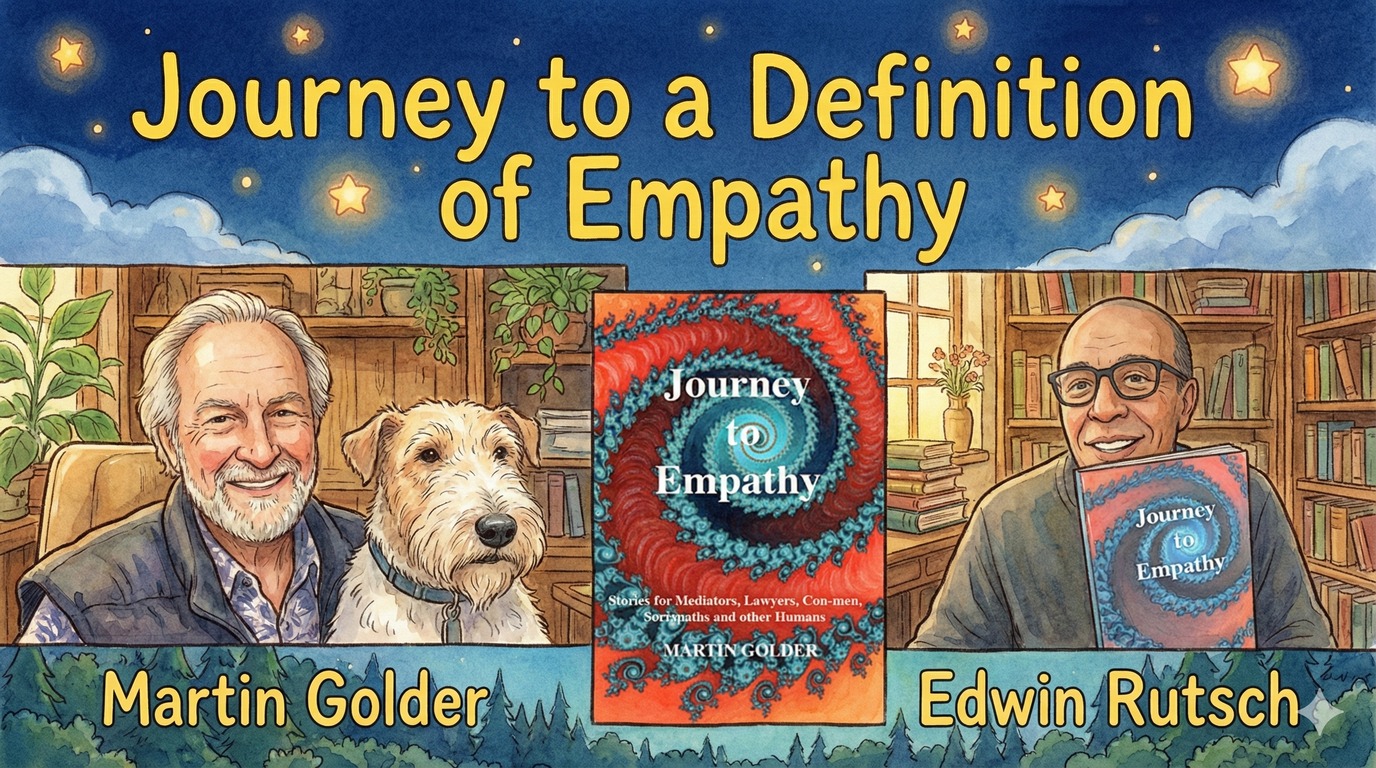
Edwin Rutsch and Martin Golder discuss the concept of
empathy, its definitions, and its practical applications. Martin, a retired
architect and mediator, shares his journey from mechanical empathy to
genuine empathy, emphasizing the importance of understanding and connecting
with others. They explore the definition of empathy, the role of empathy in
mediation, and its impact on brain structure.
Edwin introduces his model of Wholistic empathy, which
includes self-empathy, imaginative empathy, and empathic action. They also
discuss the potential of empathy circles to bridge political divides and
improve societal dynamics, advocating for empathy as a tool for better
communication and conflict resolution.
Action Items
- [ ] @Edwin Rutsch - Advocate for empathy and ask
Democratic candidates at the upcoming Democratic state convention to take
part in recorded empathy circles
- [ ] @Edwin Rutsch - Arrange empathy circles at UC
Berkeley and prototype a 24-hour 'empathy tent' or similar presence at the
California state capitol to model mutual empathy and dialog
- [ ] @Edwin Rutsch - Follow up and arrange empathy
circles at Northwestern with the student who expressed interest
(coordinate logistics and dates)
- [ ] Connect Edwin Rutsch with the former Madrid lawyer
contact who later discussed empathy (make the introduction)
- [ ] Locate and play back the recorded segment (or
quote) referenced earlier to review the point about burnout and empathy
(confirm availability and playback)
Outline
Martin Golder's Background and Transition to Mediation
- Edwin Rutsch introduces Martin Golder, a retired
architect and mediator, and author of "Journey to Empathy."
- Martin explains his transition from architecture to
mediation, highlighting the overlap in skills like project management and
conflict resolution.
- Martin shares a story about a lawyer who suggested he
become a mediator, leading him to take courses and enjoy the practice.
- Martin discusses his initial struggle with
understanding empathy during his mediation courses and the concept of
"mechanical empathy."
Exploring Empathy and Its Definitions
- Edwin and Martin discuss their long-standing interest
in empathy and Martin's travels to Europe to explore the European
mediation scene.
- Martin mentions attending a conference in London on
"Empathy and Compassion in Society" and meeting Olga Clemente, who had a
PhD in empathy.
- Martin talks about the Center for Compassion at
Stanford and the exciting discoveries he made about empathy and its
scientific study.
- Edwin introduces his book "Journey to Empathy" and the
concept of holistic empathy, which he defines as a combination of
cognitive and affective empathy.
Holistic Empathy and Empathy Circles
- Edwin elaborates on his definition of holistic empathy,
emphasizing the importance of listening and understanding the fullness of
a person.
- Martin agrees with the concept of holistic empathy and
discusses the cognitive and affective aspects of empathy.
- Edwin explains the empathy circle, a practice where
participants take turns speaking and reflecting back their understanding,
fostering mutual empathy.
- Martin praises the empathy circle as a powerful
technology for group dynamics and its potential for improving various
aspects of life.
Challenges and Benefits of Empathy
- Martin and Edwin discuss the challenges of maintaining
empathy in professional settings and the importance of staying neutral.
- Martin shares a story about a technique he used in
mediation that led to a 100% success rate in resolving conflicts.
- Edwin and Martin talk about the impact of empathy on
reducing burnout and the importance of having time for personal
reflection.
- Martin emphasizes the role of empathy in improving
group dynamics and the potential for empathy to change brain structure and
improve overall well-being.
Empathy in Different Cultures and Contexts
- Martin and Edwin discuss the cultural differences in
how empathy is perceived and practiced, using examples from the UK, Spain,
and Italy.
- Edwin explains the concept of feeling reason and how it
differs from the American and British models of cognitive and affective
empathy.
- Martin shares his observations on how national
characteristics influence the practice of empathy and the importance of
understanding these differences.
- Edwin and Martin discuss the role of empathy in
addressing social issues like immigration and the importance of mutual
understanding.
Empathy in Political and Social Contexts
- Edwin and Martin discuss the role of empathy in
bridging political divides and the potential for empathy circles to foster
mutual understanding.
- Martin shares a story about the impact of empathy on a
mediator's approach to conflict resolution and the importance of staying
neutral.
- Edwin talks about his work with the empathy tent at
Berkeley and the challenges of fostering empathy in highly polarized
environments.
- Martin and Edwin discuss the potential for empathy
circles to be used in government and political settings to improve
decision-making and reduce polarization.
Empathy and Human-Centered Design
- Edwin introduces the concept of human-centered design
and its reliance on empathy to create innovative solutions.
- Martin shares his experience as an architect and how
empathy played a role in designing low-energy housing and resolving
conflicts between clients.
- Edwin and Martin discuss the importance of empathy in
creating inclusive and effective designs that meet the needs of diverse
groups.
- Martin emphasizes the role of empathy in improving
communication and collaboration in design and mediation contexts.
Empathy and Personal Growth
- Martin reflects on his journey of writing "Journey to
Empathy" and the personal growth he experienced through the process.
- Edwin and Martin discuss the impact of empathy on
personal well-being and the importance of practicing empathy regularly.
- Martin shares a story about a lawyer who initially
dismissed the importance of empathy but later embraced it in her work.
- Edwin and Martin discuss the potential for empathy to
change brain structure and improve overall well-being, both personally and
professionally.
Empathy and Social Change
- Edwin and Martin discuss the potential for empathy to
drive social change and improve societal well-being.
- Martin shares his vision of empathy as a tool for
improving group dynamics and reducing conflict in various settings.
- Edwin talks about the potential for empathy circles to
be used in government and political settings to foster mutual
understanding and reduce polarization.
- Martin and Edwin discuss the importance of empathy in
addressing social issues like immigration and climate change and the
potential for empathy to create positive change.
Empathy and Future Directions
- Edwin and Martin discuss the future directions of their
work and the potential for empathy to drive positive change in society.
- Martin shares his thoughts on the importance of empathy
in improving group dynamics and reducing conflict in various settings.
- Edwin talks about his plans to ramp up the empathy tent
initiative and the potential for empathy circles to be used in government
and political settings.
- Martin and Edwin discuss the importance of empathy in
addressing social issues and the potential for empathy to create positive
change in the world.
TRANSCRIPTS
Edwin Rutsch 0:02
Okay, hello everyone. I'm Edwin Rutsch, the director of the empathy center,
and this is our dialogs about empathy. And today I'm here with Martin Golder,
and Martin's retired architect and mediator and also author of Journey to
empathy, which is what we want to talk about today. So thanks for joining me
today, Martin, for this discussion about empathy. My pleasure and you want to
say more about your background or who you are you're so I mentioned your
architect and mediator. Is there more? By way of introduction?
Martin Golder 0:42
I guess I don't want to get too carried away, but I guess the one thing that
could fit in the introduction was the shift from architecture to mediator. I
mean, I was really only a mediator off the side of my desk for about 20 years,
but a lot of architecture was like project management, solving problems,
bringing conflicts together, coming up with solutions, and those kind of
things. And so I was doing a house for a lawyer, and she said, You should be a
mediator.
And I said, Oh, what's that? You know, no idea, really. And anyway, she was
a mediator, and she recognized the skill. She said I was such a did such a
good job between her and her husband on the design of the house. So anyways,
she plugged me into some courses and things, and I took some courses, found I
quite enjoyed it. And then had a few cases, and quite enjoyed them, too, and,
oh, I'll go into the empathy story, the introductory empathy story here,
because it kind of fits here. When I was taking all these courses on on
mediation, the central skill of mediation is, in fact, empathy, you have to go
to the place where the participants are, where they're living. You have to
understand where they're at and really be there with them.
And so all the books talked of this empathy, and I must confess, at
the time, I really didn't have a sense of what empathy was at all. It was a
bit of a mystery. So, you know, I looked up various definitions and came up
with, you know, the old walk in the other shoes and, and that kind of thing.
And, but I would find myself in, in, in mediations. I I'd be in the mediation
and I, I would be thinking, get a life body stop whining, you know. And then I
would be saying that must have been very difficult period for you to go
through, you know, complete disconnect between my inside, judgmental and
evaluative nature and and what I needed to say, to get the job done within the
mediation.
So I began to call this mechanical empathy, because my mentor, she, you
know, I did a number of CO mediations with her, and she commented on my, my
obvious lack of empathy in her eyes. But you know, the clients couldn't see
it. I mean, the clients were so wrapped up in their own conflicts that they
couldn't see that I was disconnected, because I was going through the motions.
I was going through the motions of being there with them. And in fact, very
importantly, that's how you find out who they are, where they are, what the
problem is all about. You go into their world, and whether you do it just as a
job, or whether you do it, you know, with your whole feeling, that was the
kind of place I started out the journey from. So the journey into the world of
empathy,
Edwin Rutsch 3:59
yeah, we've known each other for like, 1112, years, so we've been talking
about empathy ever since I think we met.
Martin Golder 4:08
That's right, that's right. I, I it was, it was sort of as part of the journey
I was in Europe, and it was having a look around the European mediation scene,
meeting some European mediators and things. And I went to a conference in
London called empathy and compassion in society, and which kind of fit with my
search to find out more about this empathy. And encountered people like Olga
Clemente, who was the first person who had a PhD in empathy that I didn't even
know such a thing existed you could actually get a PhD in empathy. And then I
discovered that there are universities with whole departments focused on
empathy, and they even had access to their own fMRI machines, you know, within
their department. Departments, and they could watch people's brains while they
were talking to them and stuff. So it was quite an exciting dive into that
world. And then subsequently, that particular conference was was adopted by
the Center for compassion in at Stanford, and they ran the compassion week at
which that's when I met you there, which was a fabulous week. Oh my god, the
stuff that I learned in that week was absolutely astounding, absolutely it's
great.
Edwin Rutsch 5:36
You were able to travel to all these places you're centered in Vancouver.
Still, is that, right?
Martin Golder 5:41
Well, near Vancouver, we're on the island in Victoria, which is just off the
coast of British Columbia, yeah.
Edwin Rutsch 5:49
Well, your your book, you know, journey to empathy, is sort of a memoir. It's
like it was, you know, I learned a lot about your interesting adventures and
travels, basically around the world. So that was kind of interesting. And it's
also your journey, as you're starting to explain now, like kind of learning
about empathy and the nature of empathy. And so I thought maybe we would start
with the definitions, because I've been it's a bit of a morass, you know? Now
I don't know, even when people talk about empathy, I don't even know what
they're really talking about, you know, unless they have a deeper discussion
with them, because the definition is kind of just kind of gone all over, you
know, you're talking about mechanical empathy, and which I imagine is the
counter is genuine empathy, right? And you know, what do we mean by empathy?
And I'd sent you, you know, kind of my definition, what I'm calling
holistic empathy. I don't know if you had a chance to look at that sort of
model framework, and we can see how your your model of empathy, you know, fits
in into that so well, I could just give an outline of how I'm seeing I'm
calling. You know, there's all these definitions. There's definitions from
academia, which I think have gotten kind of muddled, very muddled. There's
like lay definitions then now on the political right, there's definitions
where they're very critical of empathy, and I think it's just almost like a
Gordian knot of of confusion about what we mean. And so to add to that
confusion, I've created my own sort of framework, calling it holistic empathy.
And it's based on the first is kind of a basic empathy, which is what you
know based on the work of Carl Rogers, which I think maybe is what you would
consider empathy to is you just listening to someone, and you're sort of
listening with your whole whole awareness to really hear who they are, what
they are, and kind of the fullness of who They are. And you know that he
developed that in sort of his explanation within the therapeutic model. And I
think as a facilitator, you're probably listening to people to really try to
understand who they are, kind of at the at the ideal, I don't know how that
that fits in with your understanding.
Martin Golder 8:21
Oh yeah, I know. I really liked the use of the word holistic empathy. It was I
hadn't actually seen that that definition with the word holistic before, and I
thought that was quite, quite nice because, but because, as you say, I mean
you have your I mean the academic, academia seems to sort of break on the
cognitive versus the effective is the sort of main two divisions.
And the cognitive would be sort of more akin to mechanical empathy with
more that, more in that realm, whereas the effective is, is like, I say it's
like, when somebody tells you a story and you understand, you know, why
they're so pissed off. But then when you go the deeper empathy, you suddenly
realize you want to kill a son of a bitch too, because boy, oh boy, he was and
you get all worked up inside kind of thing. You sort of start feeling the
feeling of the other person. This is what they're feeling, and it's, it's by
going to that place that you really start to understand where they're coming
from.
Because, well, well, sometimes it can take you a bit by surprise to, you
know, when you suddenly a feeling comes up inside. And so, I mean,
professionally, I probably stay a little bit away from that, and I stay more
towards the cognitive side, you know, just because it's a job in a way, you
know, I'm in the room, I do the job, and then I leave. I don't want to take
this home with me, kind of thing. And so I tend to keep my distance a little
bit. You know, in those kind.
Situations, but then what happens, as I mentioned in the book, is that it's
like, fake it till you make it, you know, the more you actually go through the
motions. As it turns out, as we learned from the academics and the PhDs who
are doing brain scans and things, it actually changes the structure of your
brain. You know, just the practice of empathy changes the structure of your
brain, and you that becomes easier and easier. You know, you become more and
more empathetic. And, in fact, you move into compassion, which, you know
compassion is kind of empathy with action. Is kind of how I would, sort of
think of as compassion. You're motivated to do something to help. You're
motivated to do that.
Edwin Rutsch 10:45
Yeah, I disagree with a lot of what you're saying, but
Edwin Rutsch 10:53
the first thing is, let's tackle this cognitive, affective empathy that you
know Carl Rogers, because I'm really basing the the basic empathy on the work
of Carl Rogers and and I'm also the, you know, define empathy within the
context of the empathy circle. Because these, these, it gets very sort of
abstract. You know, about what we're talking about when we're talking about
empathy, people start throwing out all kinds of ideas, and before you know it,
there's the whole wagon is going, you know, downhill and very fast and and
it's all kind of falling apart, if you ask me, and you don't know what we're
talking about, because it, because it's not very specific.
So, you know, Carl Rogers, he did, he, he, what I like about his work is he
had a practice, and then he had kind of theory and the scientific component of
it. And I think that's one of the problems with a lot of the academia. It's
purely in the theoretical and they get lost in the theoretical models, because
they don't ground it in a real experience. And I mean, as if, as a mediator,
you're grounded in real dynamics of what's happening and there's there's
success and failure in the in the facilitation. You know that your mediation
that you're doing.
So with Rogers, he is a therapist, he would just listen to his clients as
and he would just say, you know, tell me about what's going on. They would
say, Well, I'm having a really hard time, you know, with my partner, you know,
we're having all these issues and and then so he would just, he would let
them, he would be trying to sense into the experience what pain that they're
feeling, or what joys, or just the wholeness of who they are, and and the
method that he kind of used was just to reflect back his understanding of what
the speaker, his clients were saying, just to reflect his understanding,
really, to make sure that he's following accurately, sort of an accuracy,
accuracy check, and also a sense of staying present. It helps us stay present
with with his client and so and he would do that for an hour, just listening
to them, not giving them any advice, not giving suggestions, not saying
judging them, not analyzing them. You know, just, I'm here.
This is your journey, you know, journey to empathy. I'm going to follow
along with where you want to lead. And you know, your personal growth is going
to cut. Your growth is going to just, you know, come out of, you know, your
own, your own insights, they come up, and I'm just here to accompany you. And
so the model I'm using holistic empathy is grounded in taking that into a
mutual empathy. Because one problem I see with therapy is it's not mutual.
It's like Rogers is listening, the therapists are listening, but the client is
not listening in return. So it's not a mutually empathic relationship, or, you
know, holistic empathic relationship. So we have the process that, you know, I
use is the empathy circle, which is we have maybe four people.
One person is a speaker. Other, you know, you select who you want to have
listened to you, like Rogers would listen to you, that person you know you
share, and then that person reflects back their understanding of what they
hear you are saying. And if they're accurate, you continue. If not, you you
correct. You know say it. In other words, because the goal is for you to be
heard and understood to your satisfaction. When the speaker is done with their
time is up, we have, you know, limited time five minutes, maybe then the
listener becomes a speaker, and they select someone in the group, and we go
around like that for the time allotted an hour, two hours, and. And so within
that context is what I like to ground what we're talking about. You know, it's
like, Where does cognitive empathy, affective empathy fit into that dynamic?
Where does mechanical empathy, or genuine empathy fit within that dynamic? So,
and that, that's what I'm grounding, sort of, my model is in, in that, and we
can experience it too. It's not just hey, it's some abstract thing. We can
actually do it and and experience, experience the empathy, and be very, more
precise. So, thoughts,
Martin Golder 15:39
yes, yes, yes, I got, I got a momentarily distracted because my dog barked,
and so I had a momentary distraction then. But yeah, I mean the Carl Rogers,
yes, foundational, really foundational to the whole world, but the empathy
circles, I you know, it's definitely, I think, the most powerful I call it a
technology, if you like, the most powerful technology, I think I've come
across in in group dynamics of all kinds of sorts. And I've certainly used it
in quite a few, few situations. I don't know whether I should have been paying
royalties to do that, but it's
Edwin Rutsch 16:25
free to use. We try to spread as widely as possible. Our goal is to teach
everyone in the world how to take part and facilitate one so thank you for
your participation.
Martin Golder 16:36
Okay, a modest goal, but it is and, and I certainly I mentioned in my book,
you know, for any kind of group or that, you know, wants to improve in
virtually any way, so, like at the corporate level, or or whatever, you know,
empathy circles is a great place to start. And, and the process of, of really
listening and then getting the validation, because you, you feed it back, and,
oh, no, I got it wrong. Oh, really, oh, okay, and try again, and you get it.
Oh, yeah, I feel heard, okay, I got it. I think it's, it's, it's brilliant. I
mean, it's brilliant and, and I could recommend it in any situation. So I
guess in listening within an empty empathy circle, you're listening. I mean,
that's this, this is very cognitive. I mean, you're, you're understanding what
the person is saying, and then you're feeding it back to them. And the could,
in fact, you know, you could be in total disagreement. I mean, with that
person, which is fine, you don't even, you don't even go there, as you know,
you just, you, you don't even go there, because you're focused on on the
person themselves, and you feed back to them. Well, I see you really like
killing hippopotamuses and eating them, do you? You know? And, yes, yes,
that's what. Oh, okay, you know. So it's, it's, it seems to be very much on
the cognitive side. To me,
Edwin Rutsch 18:29
how would you Well, I see, I see a whole cognitive affective model is like,
kind of out of date. I think, okay, the whole, the whole framework, is very
feeling. Reason is two separate things. I think that you can't pull them apart
like that, or effectively so when you're listening to someone about the
hippopotamus, you can sense their joy. Oh, I love hippopotamus. It tastes so
good, you know, it reminds me of my of, you know, hunting hippopotamus with my
father, and it just brings real joy to my life to remember. And the adventure
of hunting a hippopotamus is so great, you know. So you can feel, sense their
enthusiasm, and I can say, Hey, I hear you really, you know, enjoy
hippopotamus. You're really happy, and it's bringing back all these positive
memories.
So I'm I'm hearing both the logic of how the the logic of how things
relate within their life, as well as the individual sense of feeling within
right in that. So I don't think you can pull that apart, okay? I mean, there's
sort of degrees. You know, some people are very speak from very logical point
of view, but the logic has a Celtic sense too. It's like you can feel the
logic and the control of someone. So I think it's a, it's a, I think the
European. You know, like the phenomenologist, they're more in terms of the the
togetherness of, you know, reason and feeling. And I think Rogers was
considered more of a phenomenologist, and this separation of reason and and
feeling is more of a American, you know, British Anglo, you know, kind of a
model that I think is kind of an albatross, I think around, you know, progress
really. So I don't know how that resonates.
Martin Golder 20:37
Well, you know, when I think of when you said, in the European and the Anglo
and all those things, sort of national characteristics. And you know, the
Brits, for instance, would probably say that the, you know, the Spanish and
the Italians are way too emotional. And you know, how can you live your life
at that level of emotion, you know, and and the the Spanish and the Italians
will say, you know, you know, I mean, the British are just, you know, cold
blooded machines of some sort in their view. So, so, I guess there are kind of
almost national characteristics or group characteristics that come into play
in terms of how empathy fits into different cultures, and what it looks like
in different cultures.
Edwin Rutsch 21:26
I think it was some more the the feeling reason divide, seeing those sort of
opposites. And yeah, whereas I done interviews on the not interviews, but had
some sessions on what does reason feel like? The reason has felt experience to
it. When you are reasoning, it has a felt quality to it. So I just see that.
And when you're listening to someone, just as I described with the
hippopotamus, you know, it's all sort of, you know why they why they have this
feeling. You know the cause of the feeling, which is maybe the reason, right?
There's a reason cause and effect to it, or they have some judgment about it,
or but it's also mixed in with the feeling. So you can't really separate it.
You were talking, I think you are using the feelings as if, like the person
saying,
Oh, I just love the hip eating hippopotamus, and then it's like, Oh,
I love it too, right? So you're you're saying affective empathy is like, Oh, I
love eating hippopotamus too. And I would say that that's actually a block to
empathy in the sense that I am no longer listening to you. I'm getting up, I'm
getting connected with my own felt experience, kind of related to you, kind of
emotional contagion or a response. I think that that's something that the
academics have brought in, which has been a total disaster to our
understanding of empathy.
Martin Golder 23:01
This is, this is such, I mean, this is like the solution to to social worker
burnout, you know. I mean, the, I mean, people get, you know, so wound up that
they actually burn out. And, yeah, so that was, that was actually a great
little piece that you just said, I should, I should see if I could play that
back.
Edwin Rutsch 23:28
One, yeah, it's all going to be recorded. That's what I think. I think that
empathy, real empathy, actually, really helps with keeping you from getting
burned out right at one hand, because you're not getting all wrapped up.
You're focused on your understanding of the other person without you know,
because that burnout blocks your empathy, the you know your feelings. Bringing
up your feelings blocks empathy and and we you want to be heard too. But
within the empathy circle, you have time for you to be heard, and that person
will share will reflect back you, so everybody has time for that empathic
space. And that's another thing that keeps you from burned. Being burned out
is when you can share the burnout that you might be, oh, I'm starting to get
burned out when you're sharing that. It really, really helps, you know, cut
the stress and yes, yeah, the cortisol I just, I think, gets replaced with
oxytocin. So, yeah,
Martin Golder 24:33
yes, especially, you know, when somebody is telling a very disturbing, you
know, story, part of their history, perhaps, that it's just like, and you,
you're just like, you almost have to hold on to the table and, holy moly, you
know, you almost can't believe, I mean, that's almost like every day when you
turn on the news. Now, I say, somebody, my, I'm I'm having problems with my
neck, because every day I wake up and I just. Shake my head and disbelief. I
just because I just can't believe what's going on. And, yeah, it's very, very
disturbing that that can cause, yeah, can cause burnout. Or, you know, what do
they used to call it?
Edwin Rutsch 25:21
You know, when post traumatic stress, or post
Martin Golder 25:23
traumatic stress, or, you know, there was the thing. But I mean, way back
when, you know, they used to put women in mental institutions because they
were a little too, I mean, you know, very, very bizarre behavior. So, so. So
here's the thing, let's just go on to what do you think musk and his kind of
ilk think is the definition of empathy?
Edwin Rutsch 25:51
So I think he's the political right is associating empathy with leftist, you
know, philosophy. So they're sort of attacking that. But I don't think that
they're, I think we're talking past each other in terms of what we mean by by
empathy. He doesn't say that, hey, all empathy is bad. He does. Even those
critics, you know that are, you know, they talk about some positive aspects of
empathy, and then they say, can go bad. So he's his work is based on the work
of the guy who just wrote writing the book. Talks, no, not toxic, suicidal
empathy. Oh, right, yeah, and so, and he has a new book, and I've reached out
to him, said, Hey, let's have a recorded discussion. You know, they won't talk
to me the sin of empathy. You know, against empathy they refuse. You know,
I've done over 400 interviews, but they all refuse to talk to me.
And I don't even that critical, because I think if we had a dialog, we
would actually come to some shared understanding in the sense of that empathy
is just listening deeply to someone else, and mutual empathy is the mutual
listening and the see What his his so he's talking about the is, they would
talk about the problem of empathy, is you feel so it's actually kind of
feeling sorry. You feel so sorry for all the people in the world, for example,
that you want them to come illegally into the country, kind of, and that's not
what I see. That's one of the things he's really against, you know, the
immigration, and I don't see that as mutual empathy. Mutual empathy is that
everyone who's a stakeholder has, you had come into a space of dialog. So
people who are for him, you know, illegal immigration, people who are against
it, the immigrants themselves, they all take part in an empathy circle, and
they have a discussion for me. That's what would be, what empathy would be. So
definitely, that's one part of it, of the of the issue.
The other, if they're not willing to dialog, it's kind of hard to maybe,
you know, to have a discussion, to kind of clarify, I did have a discussion
with someone who was a critic of empathy. He's a student at Northwestern
University, and he was going on about radical empathy, saying that
progressives are using empathy to recruit people into wokeism, you know, and I
had a dialog with him, and he's, like, totally into empathy circles now, and
wants to hold empathy circles in it Northwestern we're kind of seeing about
arranging that. Because I don't see, I don't I think woke is, is kind of an
authoritarian approach as well. So I don't think that they're using what I
would call empathy, you know, might be sympathy or that. So anyway, that
that's part of part of it. What do you think he's What do you think about musk
and you know, his thoughts?
Martin Golder 29:21
Yeah, yeah. I mean, certainly the woke thing. I mean, at one level, you say,
Who wouldn't want to be woke? It's about caring about other people and being
aware of the situation and all those kind of things. But then when you use the
word authoritarian, that kind of like struck home a little bit because it's,
it's a bit like you have self appointed woke police. You know who and they
were. They start canceling people. That was that whole cancel cultural thing,
because they're not sufficiently woke. I mean, they're they're not
sufficiently caring. I.
Poses how they would view it of their fellow citizens or humanity. So
I think that's the generator of it too many. I mean, today, I mean in the
papers, there was something about the LBGT community not getting good enough
service in the medical system in British Columbia. And somebody was doing that
well right now. Nobody is. The system is overloaded. You know, it's, it does
very well once you're in it, but, but getting into it. You know, if you it's,
is a is quite difficult. A lot of people don't have family doctors and where,
I mean, most of the world, probably that's true. But here there's this
expectation that everybody has them.
So, you know, my wife said, Well, she reacted to that. She said, Well,
nobody gets it, you know. So it's that that on a very small scale, but if you
expand that out, I think what you were saying about, you know, being anti the
immigrants, which is obviously one of the biggest issues in the US right now,
and in fact, in in many parts of the world, and is only going to become bigger
because of climate change. You know, whole peoples are being driven out of
their countries by by the change of climate and the inability to actually live
it and in various places. So I don't know it's pretty rough up ahead
sometimes, but, you know, the empathy so we have people coming Well, I think
Minneapolis is the way the local people in Minneapolis, you know, embrace the
immigrant community in that in that town, and have come out in Their defense
is, is, is absolutely superb. You know, it gives me hope to see, to see that
what, what's going on there, in some ways,
Edwin Rutsch 32:10
and this is how it fits in with empathy. Where do you see the empathy within
that?
Martin Golder 32:16
Well, I think, you know, the local people are empathetic to the immigrants who
come into their community and are trying to settle in and become Americans and
and join in the society and they, you know, they help with that. So it's the
it's the empathy is understanding what they're going through as immigrants
coming in and wanting. Well, then you get the compassion piece, which is
wanting to help them as well. So I, you know, I would say they're both in
there.
Edwin Rutsch 32:47
Well, I can what they what the Conservatives would say as well. You're having
empathy for one side. You're not having empathy for the people who say this is
our country, and what these people are doing is actually legally illegal.
They're actually breaking the law, and you're just supporting them. You're not
supporting me. Who wants to have legal, you know, respect for the law, right?
Right? There's sort of that aspect. Well, you know what, during the first
Trump election, we had groups of right wing groups come to Berkeley, you know,
where I'm at California, to demonstrate. They're doing demonstrations. And so
there would be maybe three or 400 of them, you know, coming to demonstrate.
Then it'd be, you know, four or 500 counter demonstrators to counter them. And
then there'd be about three or four of us in the empathy tent, and yeah, and
so. And the idea with the empathy tent was, hey, we're here to listen to you.
We're here to empathize with you, right? We're not here to protest you.
We're here to hear what it is you have to say, right? And so I think that's
what the empathic approach was, was to create a space that I would have loved
to have seen, you know, 400 people from, you know, from Berkeley, lined up
saying, come. We want to listen to you and hear what you have to say and be
supporting empathic, you know, dialog and understanding. But instead we get,
you know, the demonstrators and but we tried to listen to both sides. We
listened to Antifa. You know, we could come in, then we tried to bring the
sides together into into dialog. And we have some videos of us doing it, and
you know, after the people the left and the right were in an empathy circle,
they give each other hugs, for example.
So, no, I think it's a very it's very nuanced what empathy is. It's easy to
go into one camp or the other versus. Staying in empathic presence, of just
trying to understand the other side and try to bring them into a relationship
of being willing to understand you and each other. So it's, it's, it's very,
it's very subtle. And you know, it's not what we have in the country, you know
the country, we've got the two sides. You're on one side or the other, and
it's, I think it is, it is mutual empathy that can bridge, you know, bridge
the polarization in the country. Is my, my view.
Martin Golder 35:32
Well, there's that, that empathy tent at Berkeley. I watched some of that when
you when you were doing it, and, yeah, you know, brilliant. And how can we
expand that, you know, into all complex zones, in a way? I mean, it's hard. I
guess once people are actually fighting, it becomes very difficult to do. I
guess you'd do it at the diplomatic level, but that would be about it. But
before it breaks into that, I'm sure, you know, okay, we've got, I'm trying to
think, suppose you went, you know, to Washington or something, you know, and,
and, but not with just one little empathy tent in the corner, but you, you
just, somehow you flooded the place with empathy tents, you know.
And people could come together and and and say the piece, and then go back,
hey, you know you should try those empathy tents. I just went out and tried
one. Was actually pretty good, you know. And then somebody else goes, and I
think it's, it's, I mean, I remember when I when I first heard about what you
were doing, and, I mean, I called you an empathy warrior. It seems to me that
here's somebody who's actually out there on the front lines and making this
happen. It was, it was very motivational for me, I must say. So, yeah, no, but
you're absolutely right to say that as soon as you, you know, as soon as you
put anything of yourself in, to some degree, you know, the process starts to
break down.
And which is what the world of a mediator is, basically. I mean, I know
some mediators who are actually quite prescriptive. You know, there are
prescriptive mediation where they they'll come up with solutions and go back
and forth and all those kind of things. But I've always found that every time
I tried to be prescriptive, sometimes it would lead to a solution. But nobody
liked me, they I always got bad reviews anytime I was prescriptive, but as
long as I stayed in that completely neutral, just listening and feeding back
mode, as you describe, you know, you I get high reviews, and usually a lot of
success too. And in fact, I think I mentioned in the book The one story, there
was one period where I used to get, I was getting about 66% success rate in
mediations.
And then all of a sudden, there's one year, I got 100% every single
mediation settled. So I was looking at what caused that, and it was a little
technique that had happened by accident that I had followed up on where I
mediation was was finishing, and the people were leaving, and they hadn't
solved the problem. So I stopped them as they were leaving, and I said, you
know, before you leave, I just want you both to know that you did good work
here today. You know you made you advance. You both understand better what
where the other one is, and as you go forward, this will help you, and you may
come to a resolution soon.
And there was kind of a pause, and then they came back in the room, and
they sat down, and they settled and wow, what did I do? You know? And the
thing was, it was a statement that was kind and equally kind to both parties
in the same statement. And so for a moment, they were momentarily united in
the recipient the receipt of that kindness about the work they had done
together and and that, so I started practicing that and doing it more and more
and and that, in fact, it was that that led to the book, because I wrote it up
as a paper, and I presented it at a mediation conference and got, you know,
fairly good, fairly good reception for it.
Although I was a bit the woo woo, I was definitely the woo woo part of the
program, you know, because I talked about things like meditation and and
because I had always found meditation was a very powerful tool, so I included
a bit of that in my course. So some imagine a room full of lawyers. I tell you
a little story. I was in Madrid, and I was. Ending at this conference in
Madrid. And there were, there had been a young superstar lawyer from Madrid,
very, very beautiful woman, and she had lived in, she had, she was actually
from Brussels, but she had lived in Madrid, and she knew her way around. And
so every evening, there were about 10 of us who ended up going out for supper
at midnight or 11pm or something, as you do in Madrid. And she would organize
it the restaurant, and we'd all go down. And so we became quite, quite a
little group. And so then when it came to time for my presentation, here's the
conference room, and she was sitting in the front row, right in front of me,
and she had three chairs, and she was and she, oh, she was sitting in the
front row. So anyway, in a 90 minute presentation, there was actually 20
minutes of silent meditation. So which is guided? I'm guiding a whole thought
process in these people.
So, but you got a room full of lawyers and mediators all sitting silently
for 20 minutes, and anyway, I happened to open my eyes about halfway through,
and she's laid out languidly on the three chairs like this. You know,
completely I'd encouraged everybody to sit up straight and don't lean back and
uncross your legs and put your hands on your knees and all that kind of thing.
So I catch her eye, you know, and she looks and eventually she kind of sits up
and okay, and joins the zeitgeist. But, but it was very she is. She said
empathy is no part of anything I do in my work, is what she told me at that
point. And some years later, she lives in California. Now she's she's in LA,
and she's in the in, you know, what's the, you know, the Silicon Valley kind
of thing works with various companies. And I happen to catch a little podcast
of hers, which was all about empathy. So I sent her a note, and I said, Well,
who would have sunk it? You know,
Edwin Rutsch 42:01
you had a convert. Yeah,
Martin Golder 42:06
I should connect you, actually, yeah.
Edwin Rutsch 42:10
So let's see in terms of maybe the model of empathy. Again, to I kind of
mentioned the basic empathy, which is listening. So is is, you know, I've been
listening to you, and you are listening to me, so we're kind of empathizing
with each other. And that's rather the basic empathy. The other is self
empathy. So, you know, kind of listening to ourselves, sensing into ourselves.
And since I'm basing the work on Rogers. Rogers, you know, talked about, he
didn't talk about self empathy, but that when somebody listens to you're
actually able to sense into yourself, like self empathy better, you know. And
maybe meditation would helps too, you know, you're having a sense time to
sense into your your your body, and then also, and so this kind of plays out
in the empathy circle. Then there's imaginative empathy, which it's, I think
you know you're talking about cognitive empathy.
Sometimes that cognitive empathy, they overlap it with imaginative empathy,
where you can take on the role of someone, which is a bit different, like in
the empathy circle, you we do mediation practice, you know, using the empathy
circle, and each of the participants takes on the role of a person in a family
that's in a conflict, you know, over an inheritance siblings. And so you're
taking on the role I'm this, you know, person, you know, I'm fighting for the
inheritance because, I think for the other reasons so and it's also like an
actor might take on the role, you know, Margaret Meryl Streep might take on
the role of Margaret Thatcher or Julia Child, and which is a different
phenomenon, you know, than just listening to someone directly. So like to
separate that out, and it's also, you know, it's a better term, I think, than
cognitive empathy.
Cognitive empathy sounds so dry and and boring and imaginative empathy, I
think, is more evocative and fun and more accurate to, you know, for what
they're talking about. And then there's the mutual empathy, which, again, in
the empathy circle, we we have mutual empathy. And there's a quality of of,
you know, mutuality in the circle, like, oh, we all feel heard. We all hear
each other so kind of being able to and one of the problems with empathy the
definitions from the academics, is very individualistic, right? It's all like
you is an individual empathizing with someone else, but they don't talk about
the mutuality of it, which is really the real beauty of it. In some sense, and
you're doing that in mediation, right? You're trying to create a mutually
empathic space. So the parties leave in, you know, they've got, they have more
connection, more understanding, with each other. Ideally, they care more about
each other, and they're satisfied with with the outcome, and then empathic
action, which is again in mediation, where you know you you're surfacing the
needs that both sides have, and they've vented their judgments, their
frustrations, their pain, and then also what their underlying needs are.
And then you start finding some common ground, and you say, what do we do
next? And and then somebody comes up, well, let's try this. And the other
person says, No, I don't want to do that. How about we try this? And I said,
Well, okay, I can do that, but if we do this, you know, so there's sort of a
negotiation, and there's an action that comes out of that mutual
understanding. And that's so anyway, that's what I would call empathic action,
is the action that comes out of that mutuality. And you're kind of into the
compassion group who they want to change that into. You know, empathy is just
hearing and understanding each other, and they sort of discount the empathic
action, they say it's compassion that has the action, which I thoroughly
disagree with, because, by definition, compassion is about suffering.
And so I do like freestyle dance, or used to, and you're very sensitive in
dance to where the other person is, and you're trying to and you're having a
lot of fun, and you want to increase the fun and the creativity, and that
comes out of a high degree of physical sensitivity to where the other person
is, where they're moving, where you sense they want to move. What will happen
if I offer this, you know, how will you play off of that? And there's no pain
involved, it's all fun So, and there's huge action comes out of it. So I think
the you know, compassion group trying to grab action, the component I
thoroughly disagree with, yeah. And also, are you familiar with human centered
design? The Oh, yeah. So human centered design starts with empathy, like, if
you want to design anything, you need to empathize with the people you're
designing for, and they might be in pain or not, but there's huge creativity
and innovation comes out of human centered design, and it's all empathy based,
and not necessarily compassion. So that's my case, you know, for Absolutely.
Martin Golder 47:44
And, you know, as an architect, I absolutely, that's how I got into empathy.
You know, was, was through architecture. Because, you know, I came into
architecture much more. I was just a techie kind of guy. I was all, you know,
early 70s, with the first oil crisis, you know, I became an, I became one of
these, like, I mean, I had been called an energy Nazi before now, you know,
because I, you know, turning off lights and, you know, all that kind of thing.
And then getting into producing, I was involved with a company, and we built
some of the first really, really low energy housing in Canada, and a model
that eventually became passive house that started in Saskatchewan and and then
with the couple, you know, who told me I should be a mediator.
It was because, you know, as I say, you don't want to build any bones
of contention into physical structure. You know, if I wanted a window there,
you didn't want to win, you know, that kind of thing. And it would be a
reminder forever if you don't sort that one out. So any bones of contention
have to be sold and not built into the structure. So definitely, that's where
it came from. And and then there was something else he was saying there, which
triggered a It was
Edwin Rutsch 49:09
no it was definitely a mediator in that, in the design, what you're saying, I
think, is in designing a house, you were mediating the different needs. People
had to find the commonality, and if there was disagreement, you were trying to
find ways to work through the disagreement, to find mutual understanding.
Martin Golder 49:30
Absolutely, absolutely. Yeah, I feel heard.
Edwin Rutsch 49:36
Feel heard to your satisfaction. Excellent.
Martin Golder 49:41
Yeah. No. I mean, it has been a great journey, I mean, and which is why I felt
at some point I should make some attempt to write it down, you know. And I
didn't do it until I was 80. But, you know, I'm happy I did it. I mean, it's.
That I am. I'm under no illusion that it's a great book or anything like that,
but it's, I hope it's quite a good read. And, you know, there's a few nuggets
in there that I think are worthwhile and and I just feel better for having
written it and got it down.
That's, that was the journey that that, you know, my life took me on and
and coming out. I really, really like the piece that the practice, you know,
affects your brain structure, and that that, to me, is like, really, really an
important reason to go down this path, because it's only going to go get
better if you go down this path. That's it. And so in terms of the the larger
movement, the empathy movement, you know, I appreciate the concern that you
expressed, how empathy has often been sort of focused on the individual and
but, but you've always been focused on a larger empathy movement, and how can,
how can we make this not just about the individuals, but about the society at
large, and make it better and and the certainly the empathy circles, the
empathy tent, and those kind of initiatives have had great impact, I think so.
The one I was kind of looking at was I wrote the book under the title. The
working title was mechanical empathy, because that's what I felt it was when I
was actually writing.
Although the initial course I used to teach was called Journey to empathy.
And then I went back to that at the end, when I decided to put the book, I
decided to go back to the original title. So in terms of the larger community,
the work you did with, you know, Republicans and and the Democrats, or
whatever the division was there at Berkeley. That is obviously a hugely
important societal divide that is just screaming to be bridged. I like the
fact that you have a bridge behind you as your background. And so the thing
that I I would say, is that, you know, even if you're a really, I know even I
hesitate to go as far as somebody like Stephen Miller. But even if you're
really, like, really kind of not very nice person, for whatever reason, if
you, you know, were convinced to try just the mechanical empathy, just use the
mechanical version of the empathy, it would not only be better for you, you'd
get better results. As I say, con men, they have to know their marks, you
know. You got to know your mark.
You got to go in there. Lao, Tzu, you know, you keep your enemies closer.
And so you've got to be close to people you consider enemies or not, and bring
them in close. And then, I guess a little bit here, I'm sort of hanging my hat
on the fact that if you do that, it's going to be better for you. You're going
to have better results. I mean, all kinds of CEOs have tried, you know,
empathy things in their companies, and found that it improves all kinds of
things. But is that it changes you. You know, when you do it, even if you do
it mechanically, it changes you. And you know, my, my, my belief is that
ultimately, the changes in you will benefit the society at large, rather than
if you didn't do it. So it's good for everybody. That's so it's a bit of a
it's bit of a silver bullet,
Edwin Rutsch 54:03
yeah, well, the rewiring, I think with you know that you get better at it. I
see that with the empathy circle, because the empathy circle, you're sort of
practicing the active listening. And I think what you're referring to is
neurons that fire together, wire together. So there's a neuro pathway gets
formed when you're just focusing on listening and not responding and judging
people. I mean, you know, you know, I know myself. I can get quick to judging,
right? And so those neurons, those pathways in the brain, are getting every
time you're judging, you know, I'm get I'm reinforcing those neural pathways.
But if I take part in an empathy circle, and I'm constantly listening to
people, those neuron pathways are firing together, so it gets easier to
empathize. You know, in other situations.
And an example, I know one person who was doing. Empathy circles, you know,
she, she mentioned that she was driving with her her son, and her son said
something about their family, and she started getting defensive, you know
about it, you know, kind of got her hackles up and getting and and then she
said, Oh, I do empathy, right? So then, you know, I can just do Oh. She said
something kind of defensive, and her son said, yeah, yeah, you're whatever,
you know, kind of dismissing her. But then she she remembered the empathy
she'd done it, and she stepped into that mode and says, Oh, you're saying is
this? And he says, yeah. And then he started continuing what he was saying. So
she stepped into the empathic mindset with her son, and she said it turned out
to be really great days they were traveling from Santa Barbara to the Bay Area
or something, and that they just because she'd stepped into that different and
having practice the empathy circle, I think kind of helped her step into that,
that that mindset, so just kind of building, I think, on, on what you're
talking about,
Martin Golder 56:09
brain, yeah, that's beautiful. That's beautiful. And it's the conscious action
of stepping into that framework. You know, you learn the framework and but,
but making that conscious decision that's like so important to do that. I
mean, one little story I tell was the guy who was Canadian mediator, and he
was mediating for the United Nations with with Kony, the the warlord, and I
think it was Uganda. And so they were trying to get some kind of piece
together. And so they had this meeting set up in the middle of the jungle, and
they've got the tables there and and, you know, the jungle is full of coney's
troops, all fully armed to the teeth, you know. And he's walking out to the
table, and Coney is coming out of the jungle, and he thought, well, maybe my
contribution, you know this, this, first of all, you have to understand the
methods of recruiting a child soldier. You know these people, they would go
into a village, they'd pick, likely, 14 year old, give him an AK 47 and tell
him to kill his family.
And if he didn't kill his family, they would, and they'd kill him as well.
But if he killed his family then. And so, you know, he would do it. And so in
one motion, he'd learned how to use an AK 47 he was completely brutalized, and
he had nowhere to go back to. I mean, this is, you know, you can't imagine a
greater definition of evil, if you like. And so he thought, well, if I was
carrying a gun, I could just kill him. I could walk up to the table, shoot
him. I would go down in a hail of bullets, but that would be my contribution,
you know. And then he said, Oh no, I better switch on my empathetic. I'm a
mediator here. I'll switch on my empathy. So he switches on his empathy for
Coney, and realizes right away that that was how Coney had originally been
recruited himself. He had been a child soldier. He had been brutalized and
brought into that and that by switching on that mode, you know, completely
changes the way you go into the situation. So I think that's a beautiful story
of the consciousness of switching on the empathy.
Edwin Rutsch 58:22
Yeah, yeah. Well, you'd mentioned, you know, spreading empathy, kind of the
empathy movement, and, you know, setting up the tent and stuff. I have been
thinking of, of an Occupy empathy. Maybe you could run that by you where,
where it's, you know, the empathic approach I see is a counter culture. It's
counter to Democrats and Republicans. You know what they're what they're
doing, because they're very much into the into the battle that we actually
instead of an Occupy where it's a 99 against the so called 1% it's 100%
empathy.
And we're there. We're saying, and you know, in the United States, you can
pitch petition for redress of grievance to the government, and the grievance
is that the polarization in the country is is not good for the country. It's
causing harm and damage to the country, and we're petitioning that the
government redress this by, you know, fostering mutual empathy and starting
with the left and right, taking part in empathy circles with each other. But
like Occupy, we actually occupy a space, you know, and create sort of a model
counter culture. So, you know, we set up it in the capital mall here in front
of the Capitol, and it's like 24 hour empathy circles. You know, if you come,
if you want to be part of this movement, you just take part in an. Circle with
others and and then maybe other, you know, positive, you know, democracy
building practices as well, but to really, you know, model this empathic
approach.
So I'm toying with that. We're, we're going in a couple of weeks, to the
Democratic state convention here in California, here in San Francisco, we're
going to be advocating for empathy. Then I'm thinking of going next to UC
Berkeley, which is nearby, and just kind of being out there with the students.
And then I'm sort of thinking maybe we could go to the California state
capital to sort of prototype it, and say, we want the Democratic and
Republican legislators to take part in empathy circles and kind of scale up
from there. So just thoughts, it
Martin Golder 1:00:52
would be good, I guess, what you'd want to do is have a little bit of, I
guess, the front end work, which is, you know, the first few waves of of the
legislators who are willing to take part, you know, you, you kind of do a bit
of recruiting, and so you can get, let's say, I don't know, four, four groups
of six, or something like that, that would start out doing that, and then they
can report back right to model the practice, yeah, to model the practice. So
do you think, I mean, just from your experience in in Berkeley, I mean, I
mean, do you think you could actually get let actual, are they called
legislators to make sure to come and do that, to come
Edwin Rutsch 1:01:43
and, yeah, I had run for congress here in this district, and first thing I did
was I reached out the other candidates, and two of them took part in an
empathy circle. So when, when people are running for office, they're more open
to that kind of stuff. And then there was, there was 11 candidates for our
state legislature, you know, for this district, and I held an empathy circle.
I think 10 of them came and actually took part in it, and it was actually held
on the UC Berkeley campus. So when people are running for office. They're much
more open to it. And I just noticed, you know, we have the election for the
governor here in California in this this fall, and the Democrat for the
Democratic Convention, of the candidates are going to be at the, you know, at
the Democratic convention.
So I'm thinking of asking them to take part in an empathy circle. And
I had talked to Gavin Newsom, the governor here, a couple of times about it.
The first time when he was running for office, I said, Hey, would you do an
empathy circle with John Cox, who is a Republican running for office. And he
says, John Cox has no empathy. I said, Well, if John Cox would do an empathy
circle with you, would you do it? He says he wouldn't do take part in an
empathy circle. I said, Well, if I, you know, get in contact with him, and he
says he's willing to do an empathy circle. Would you do an empathy circle with
him? And he didn't, he wouldn't respond. And then I did actually talk to John
Cox and later, and he said he would do take part in an empathy circle. But the
election was, it was like it wasn't time to he was almost at the voting time.
So, so it, you know, it, you got to kind of work at it.
And I'm hoping to maybe run into him, you know, again, at the convention,
and try to see if he would support. He's talked about empathy, the importance
of stitching together the country, you know, after Trump. And so I'm hoping we
can maybe get some support there. So you got to kind of, kind of work the
system a bit to make that happen? Yeah, I think it's, you know, if we can get
much enough support, I think we can work our way up the chain there.
Martin Golder 1:04:09
Now, would they think that? Oh, here comes it. Here comes Edwin, that woo, woo
guy, you know the Woo, the Woo, woo, empty guy. Would you, would you think,
you know the hard nosed reality of running a government and all caucuses and
things, versus this empathy stuff, empathy so it seems like soft and, you
know, and woo, would you still think that that was a perception?
Edwin Rutsch 1:04:37
Well, I know that when we set up the empathy tent, and we're in the middle of,
you know, flash bangs and pepper bombs and spray that one of I interviewed,
one of the leaders on the political right. He says, Well, we were pretty
surprised that you were there in the middle of it and, you know, staying with
it and not running off. So we. Earned some respect for, for, you know, being
in the thick of it and not running away. So I think that that's what it takes,
right? Is like is you got to show what you're if you're willing to stand up
for what you believe in,
Martin Golder 1:05:18
right? Right, right, but
Edwin Rutsch 1:05:21
there's certainly that criticism, yeah, oh yeah. They want you to battle. If
you're not fighting the other side, then you're just a wimp, you know?
Martin Golder 1:05:29
Yeah, yeah, right, right, yeah, yeah, no, I was always a bit of the woo, woo
part of the program at conferences.
Edwin Rutsch 1:05:41
Well, okay, well, those are just some ideas. Where were you going next? With
your empathy work?
Martin Golder 1:05:47
Well, I mean, just our conversation today kind of opens new some new doors,
some new paths to have a look down. I'm I, I guess I'm, I don't know whether
you, oh, you, I think you did see that you said you did the one the podcast
out of Austria, which I was quite surprised when she put it out under the
title gangster empathy, you know. And but then when I thought about, I
thought, Oh, well, yeah, because I, because I was sort of talking about, you
know, con man and and and other ne'er do wells who would use what would to all
intents and purposes appear to be empathy in their in their criminal
activities. And so I think that's where the title gangster empathy came up.
But it, you know, it works for works for everybody, you know, even the bad
guys. That was kind of my whole point, really was that if it works for
everybody, then why not do it now? You said, well, we don't want the bad guys
to be able to do what they do better. We don't want them to use empathy and
then they can do what they do better than that. But I think the point I was
trying to make was that while that may be initial, you know, the downstream
outflow of them actually going down that path benefits the larger group,
benefits society other than, better than if they choose some other method, you
know, to do their deeds you know, like maybe just, you know, kill people, have
them oft you Know. So there are other other ways forward,
Edwin Rutsch 1:07:41
promote empathy with con men.
Martin Golder 1:07:44
Well, well, you know, that occurred to me. I mean, that's on my book. It says,
you know stories for lawyers, mediators, con men, sociopaths and other humans,
you know. So, you know, if you are a con man, and you want to up your game,
then bringing empathy to it is is going to do that. Now, I don't want to be
seen as encouraging people to use empathy for for crime, but in fact, they
already do. I mean, if you're, that's it. I mean, you're, they're already
using what certainly looks like empathy, you know? I mean, it's because of the
the intention that is going on behind the scenes. You know, it's, it certainly
doesn't have any of the the positive values that we would describe to empathy,
in terms of getting along better with your fellow humans.
Because the the I you have this intention behind which is a dastardly
intention, but the point I was making. And I, you know, you know, I'm, I mean,
these are all discoveries, I think so I, you know, I never be totally sure
about anything, but the observation and the path that I've sort of come to is
that ultimately it's better for everybody to have everybody use empathy,
regardless of what they're doing. Use empathy to to make happen what you want
to happen. Use it as a tool. Learn how to do it. Use it as a tool, and
ultimately, it's going to work out better for everybody, including you. So
that was kind of so now if we could with with, I mean, yeah. I think the you
know, when you had the empathy tent with, you know, that hugely polarized
political system, I suppose it in a sense, when everybody comes together in
Congress and the meeting rooms and the Senate and those kinds of places like
our parliament.
Like, you know, Parliament was designed with the seats two sword lengths
apart. Basically, you had the, you know, the rich guys over there, and you had
the working people over here, you know, labor versus the Conservatives and and
they had no commonality in the way they thought society should be run. You
know, they they were and they were willing, they would be willing to kill and
for what they believed is the way that society should be run. But it's better
to come together in a space where you can hammer it out, basically, where you
get your say, you know, in the back and forth that happens in our parliament,
I mean, people always comment on question period as being this. It's like kids
in school throwing insults back and forth at each other across the floor, and
rather than grown men trying to run a country and grow people, not men. I
shouldn't say that. I'm thinking back to, you know, a long way back when it
was designed.
But, you know, the behavior, people always comment on the behavior being
really, really bad. But what would be worse is, you know, if they were hurling
bombs back and forth across the aisle and fighting, physically fighting. So
anyway, I want to go too far down that path, but I was kind of thinking of,
how could you bring the actual mechanics of your empathy circle into actually
governing committees. Governing committees, I guess there's this guy, you
know, the guy who does the those the other citizens assemblies. You know,
citizen assembly model, that kind of thing has been tried a number of places
with quite a bit of success, and has quite a bit of sort of empathy circle
dynamics built into it. Well, yeah,
Edwin Rutsch 1:12:12
well, with the politicians, you know, I was saying there should be a policy
that Republicans and Democrats have to have an empathy, a recorded empathy
circle once a month with, you know, two people on the right, two people on the
left, and with the topic of, how can we bridge our, you know, political,
social, political divides. And that's, you know, two hours, at least two hours
a month. And that would be for all of them so and that they're recorded so
people could see the discussion, and so they would be modeling listening and
dialog with each other. That's one, yeah, one.
One idea in terms of citizens assemblies, I think that empathy
circles would be a gateway that the participants first start with an empathy
circles with each other, and then move into the next levels. Because I see
that as a sort of a trust building practice. And we had worked with extinction
rebellion in the UK, and they had a future, something called Future democracy
hub, where they had different practices, like People's Assembly, citizens
assemblies, and they had empathy circles as a practice. That is sort of a
first step, you know, practice. So I think, yeah, can can? I think all this
stuff is very doable, and what I'm hearing, too from you is the you're saying,
what you're going to let people know that whatever your self interest is,
empathy is going to help you get whatever it is that you want. So try it out.
Absolutely.
Martin Golder 1:13:54
Yeah, no, I love that one, the idea of having politicians, having two on two,
whatever it is, as a regular thing, that would be absolutely brilliant, you
know. And you could probably, you know, find enough to start that ball
rolling.
Edwin Rutsch 1:14:11
Yeah, yes, that's what I mean. That's kind of the direction I'm going, you
know, I'm thinking we've done a lot of, you know, work on the computer and on
writing and all that kind of stuff. And now it's time to get out with the
empathy tent again. So we're just starting to kind of ramp that up, get get
that going. And I think now with the political situation, you know, it's
there's actually an opportunity for something new. You know, Trump's been a
bit of a wrecking ball, kind of wrecking everything. And now it's like, what
do we build new? And it's actually an opportunity. I actually see it as an
opportunity for saying, you've tried, you know this, let's try people working
together and and. And organizing around mutual empathy and dialog, listening,
yeah, yeah.
Martin Golder 1:15:06
Normally, government is fairly incremental, but at this moment, you've got an
opportunity for, you know, a whole scale change, and one of which obviously is
is going to be eliminating the completely and utterly ridiculous situation
where we have billionaires. How idiotic is that that, you know, and I guess
that's why they're all kind of lined up trying to fight off the hordes,
because, you know, they're coming with pitchforks. And so, yeah, it is so, so
silly. So, yes,
Edwin Rutsch 1:15:46
maybe you can get Elon Musk into an empathy circle.
Martin Golder 1:15:49
Yeah, there you go. Yeah, yeah. Okay, Elon, you said that empathy is the
Achilles heel of Western society. Come check it out there. You know, yeah, who
would you have on? Who else would you have in there with him?
Edwin Rutsch 1:16:03
Yeah, yeah, sounds like you probably need to go even going, Yeah, hour and a
half. So yeah, we have okay. So yeah, I would say, probably get sad the person
that he's quoting, you know, who's talking about suicidal empathy, yeah. Now
we have some people from our group, which would be good, her good, you know,
grounded in, in the empathic approach, I think, yeah, you know,
Martin Golder 1:16:33
okay, well, I guess, oh, my dog's coming in to say hello. Now, hello.
Edwin Rutsch 1:16:38
Okay, well, great, talking to you, checking in and, you know, stay in touch
and we'll be Oh, there he is.
Martin Golder 1:16:46
Okay, okay, yeah, really nice to see you.
Edwin Rutsch 1:16:51
Everyone. Journey to empathy. Okay, take care. Okay. Bye.