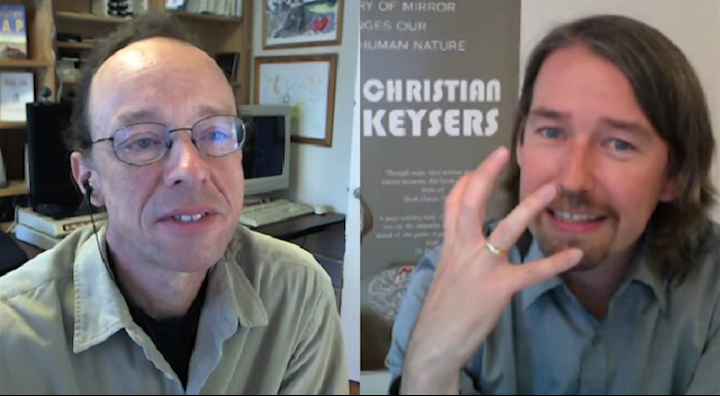
Christian Keysers is professor and group leader of the Social Brain Lab at
the University Medical Center Groningen in the Netherlands. The lab
explores the biological nature and neuroscience of empathy.
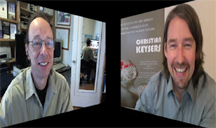
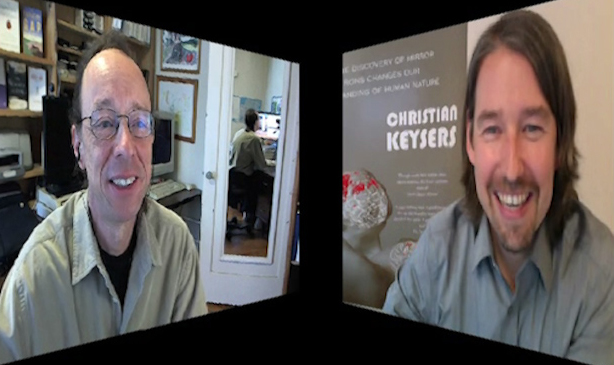
In this interview, Christian gives a chapter
by chapter narration of the book, which explores the nut's and bolts
neuroscience of empathy. In the book, he illustrates the science with
his own experiences and with stories. The journey starts at the lab in
Parma, Italy where mirror neurons were first discovered and where he
also worked.
Sub Conference:
Science
Christian Keysers is professor and group leader of the Social Brain Lab at
the University Medical Center Groningen in the Netherlands. The lab
explores the biological nature and neuroscience of empathy.
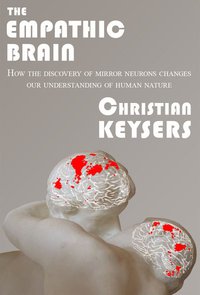
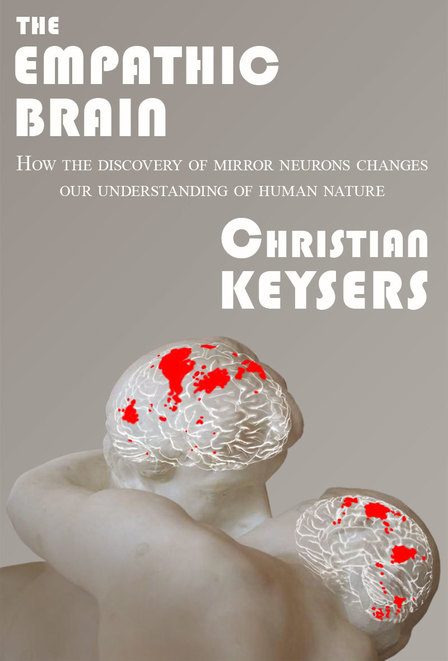
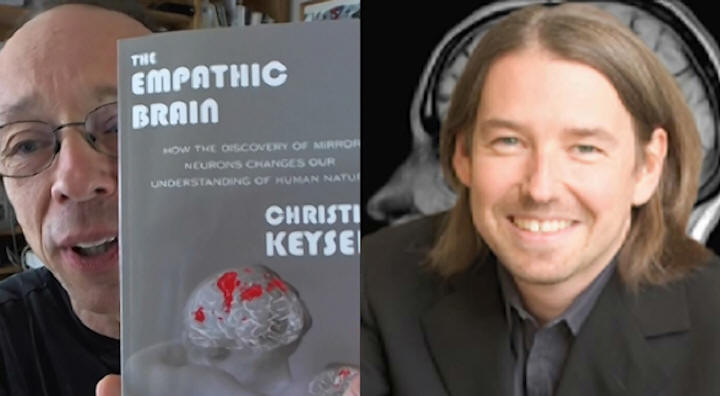
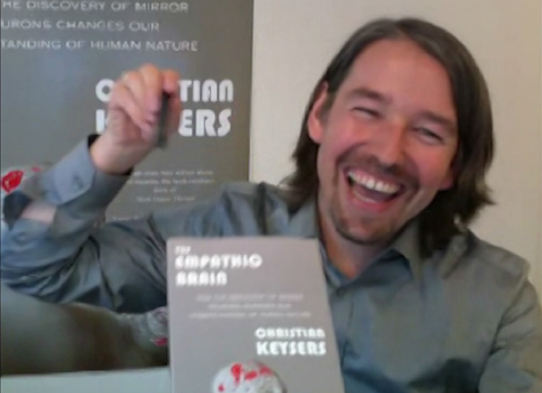
Christian is author of 'The Empathic Brain: How the Discovery of Mirror
Neurons Changes our Understanding of Human Nature'.
Christian
discusses his teams new findings.
"A brain imaging study in the Netherlands shows individuals with
psychopathy have reduced empathy while witnessing the pains of others.
When asked to empathize, however, they can activate their empathy."
ScienceDaily Sub Conferences:
Science
and
Pathologies
Dr. Christian
Keysers - The Empathic Brain
Nov 9, 2018
At our 2018 Research Symposium, Dr. Christian Keysers spoke about the
science behind empathy and what makes us social as humans. Dr. Keysers
is the Co-Founder & Co-Director of the Social Brain Lab at the
Netherlands Institute for Neuroscience and is a Professor of Social
Neuroscience at the University of Amsterdam.
KEYSERS GROUP
We try to decipher the brain circuitry that makes us empathic.
Or what Christian Keysers present the lab at the Marie Curie Action’s 20th
Anniversary in Brussels
Why is it that we can get sad, when we see someone else crying? Why is it that
we wince, when a friend cuts his finger? Researchers from the Netherlands
Institute for Neuroscience have found that the rat brain activates the same
cells when they observe the pain of others as when they experience pain
themselves. In addition, without activity of these “mirror neurons”, the
animals no longer share the pain of others. As many psychiatric disorders are
characterized by a lack of empathy, finding the neural basis for sharing the
emotions of others, and being able to modify how much an animal shares the
emotions of others, is an exciting step towards understanding empathy and
these disorders. The findings are published in the leading journal Current
Biology.
In our first Living
Room, Empathy: the monkey and the peanut playwright and campaigner, Sarah
Woods, and neuroscientist, Professor Christian Keysers, explored the science
behind empathy, and the part that mirror neurons in particular play in
activating an empathic response in us.
In this short film Sarah and Christian speak about how their curiosity about
empathy first arose, the journey their explorations have taken them on, and
what they have learnt about empathy through art and science
2015-01-16 -
The straw man in the brain
Pop culture claims about the brain make for easy targets, finds Christian
Keysers
"Unfortunately, these
examples are not exceptions but are reflective of Hickok’s methods throughout
the book: He presents and then deconstructs dramatically oversimplified claims
about mirror neurons, implying that these reflect the proposals of the
scientists working in this field. His refutations of these claims are passionate
and compelling but, ironically, lead down the very path of mystification he
tries to denounce. "
"While we watch a movie, we share
the experiences of the actors we observe: our heart for instance
starts beating faster while we see an actor slip from the roof
of a tall building. Why? Specific brain areas are involved when
we perform certain actions or have certain emotions or
sensations. Interestingly, some of these areas are also
recruited when we simply observe someone else performing similar
actions, having similar sensations or having similar emotions.
These areas called 'shared circuits' transform what we see into
what we would have done or felt in the same situation. With such
brain areas, understanding other people is not an effort of
explicit thought but becomes an intuitive sharing of their
emotions, sensations and actions. Through the investigation of
shared circuits, our lab attempts to understand the neural basis
of empathy and its dysfunctions. "
"Psychopathy is a personality disorder associated with a profound lack
of empathy. Neuroscientists have associated empathy and its
interindividual variation with how strongly participants activate brain
regions involved in their own actions, emotions and sensations while
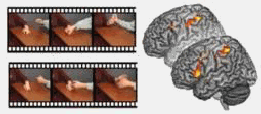
viewing those of others. Here we compared brain activity of 18
psychopathic offenders with 26 control subjects while viewing video
clips of emotional hand interactions and while experiencing similar
interactions."
A brain
imaging study in the Netherlands shows individuals with psychopathy have
reduced empathy while witnessing the pains of others. When asked to
empathize, however, they can activate their empathy.
Criminal psychopathy can be" both repulsive and fascinating, as
illustrated by the vast number of books and movies inspired by this topic.
Offenders diagnosed with psychopathy pose a significant threat to society,
because they are more likely to harm other individuals and to do so again
after being released. A brain imaging study in the Netherlands shows
individuals with psychopathy have reduced empathy while witnessing the
pains of others. When asked to empathize, however, they can activate their
empathy. This could explain why psychopathic individuals can be callous
and socially cunning at the same time.
Why are psychopathic individuals more likely to hurt others.
"A brain imaging study in the Netherlands shows individuals with
psychopathy have reduced empathy while witnessing the pains of others.
When asked to empathize, however, they can activate their empathy.
Criminal psychopathy can be both repulsive and fascinating, as
illustrated by the vast number of books and movies inspired by this
topic. Offenders diagnosed with psychopathy pose a significant threat to
society, because they are more likely to harm other individuals and to
do so again after being released. A brain imaging study in the
Netherlands shows individuals with psychopathy have reduced empathy
while witnessing the pains of others. When asked to empathize, however,
they can activate their empathy. This could explain why psychopathic
individuals can be callous and socially cunning at the same time. Why
are psychopathic individuals more likely to hurt others? "
"Anja and Rhys's love story is told from a neurological perspective,
by neuroscientist Christian Keysers. It's the story of two
individuals whose brains begin to 'mirror' each other as they
gradually fall in love. As Christian says it's "...not so much an
exchange of information as two brains becoming one."
Author of 'The Empathic Brain', Christian is Head of the Social
Brain Lab at the Netherlands Institute for Neurosciences. He seeks
to understand how, as social animals, our brains mirror those of
other people, so that understanding others is not an effort of
explicit thought but an intuitive sharing of emotions, sensations
and actions."
New study tested psychopathic prisoners by asking them
watch video clips showing pain
"It was previously thought that psychopaths lacked the
capacity for empathy but new research shows they are able to switch it
on and off 'at will'. The study took eighteen psychopathic prisoners
and showed them a variety of video clips of people hurting each other
or displaying affection. Brain activity in the regions involved with
empathy were then monitored as the subjects watched the videos."
1. The Discovery of Mirror Neurons "Mirror neurons “mirror” the behavior and emotions of the
people surrounding us in such a way that the others become part of
us. Knowing that such cells exist can explain many of the
mysteries of human behavior. For instance, why it’s so hard to
stick to a diet if you see people around you that eat the very
thing you should not. Mirror neurons provide an answer"
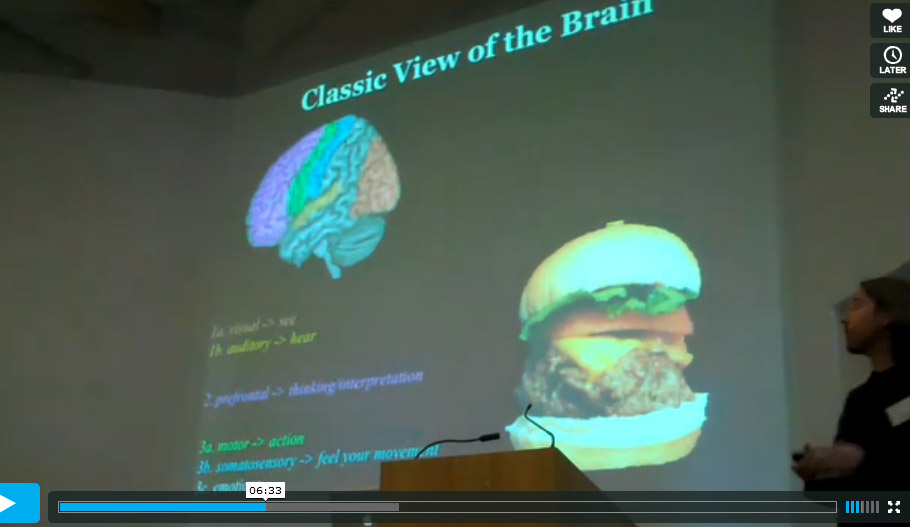
Is perception like a sandwich?
From seeing to doing
Brain function based on connections between neurons
Paradoxically, the major hurdle to understanding
the human mind is the obsession for rationality of the minds of
the scientists that study it. The second hurdle is computers.
Together, they have created the vision of a brain that processes
all information in a conscious, logical and abstract way–much as
ordinary computers do. The discovery of mirror neurons changed
this vision.
We predict the actions of others based on what we would do
Understanding others: What it would feel like to do the same
"Shortly after the team in Parma first discovered
mirror neurons in monkeys, neuroscientists interested in the
social mind everywhere in the world began to debate whether a
similar system exists in humans."
Seeing an action activates our body
Magnetizing the mirror system
From Parma to Holland: A day in the new lab
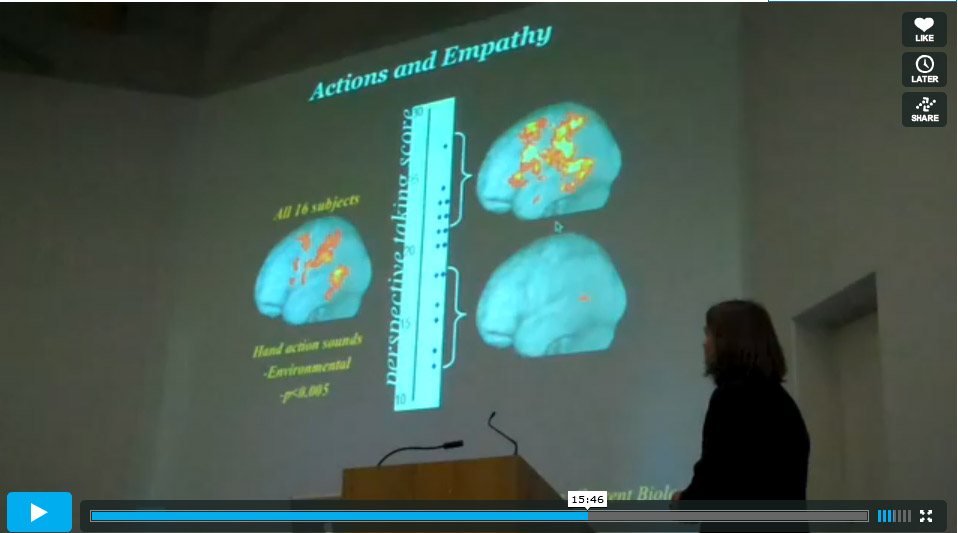
We understand action sounds through our own actions
"In a classical view of the brain, the process of
understanding other individuals relies on specialized systems in
the brain that are separate from those responsible for our own
actions. This suggests that your own motor skills should have
limited and indirect influences on your perception of other
people’s behavior. In the light of mirror neurons, the situation
is quite different."
Learning how to perform an action changes our perception
The mirror in our brain even responds to robots
How people born without hands mirror hand movements
Mirror system facilitates understanding of goals
Learning by observation
A neural basis for intuitions
Implications for teaching: an action is worth a thousand
words
Simulation is a fundamental principle of brain function
5. Language "From an evolutionary perspective, human language seems to
come out of nowhere. With the discovery of mirror neurons, this
has changed. Apes may not spontaneously use language, nor can they
learn grammar even in contact with humans—but they have much of
what it takes to do so. Mirror neurons prepare apes to realize
that they can communicate and share skills with others"
The blue banana with a hundred legs
Searching for language’s missing link
A scenario for the evolution of language
Linking the motor system with language
Bridging the inexplicable gap to language
Foundation #1: Realizing that a message came through
6. Sharing Emotions
"Our feeling goes further than our personal experience and
observation, though. While we watch James Bond being wakened by
the tarantula, our understanding is not limited to his bodily
actions—we also share his feelings. We sweat with his fear and
rejoice with his victory. The feelings of the people that surround
us are contagious."
Models of emotional communications
Emotional contagion and facial mimicry
Sharing the feeling of disgust
From mirror neurons to shared circuits
Recognizing emotion in others
Recognizing emotional sounds
You need to feel emotions to empathize with others
Connecting what you see with what you feel
The body is part and parcel of the mind
More empathic people activate the insula more strongly
Delight is also shared in the insula
The power of words
It takes one to know one
The difference between a fake and a real smile
Sharing facial expressions is essential for understanding
others’ emotions
7. Sensations
"Over the years, evidence of a mirror system for action has
accumulated and our vision of the brain has changed accordingly
into one of a more integrated system that processes the actions of
other people using the same areas that are activated while
programming our own actions."
Seeing touch is literally touching
Why it hurts to damage your car
How your pain becomes my pain
Is knowing as good as seeing?
Why being touched feels different from viewing touch
Men reserve their empathy for fair people, women don’t
8. Learning to Share
"Shared circuits appear to be ubiquitous: we activate our own
actions, sensations, and emotions while witnessing the actions,
sensations, and emotions of others. This begs the simple and yet
central question of how mirror neurons develop. In turn, we have
to ask how a single neuron can ever respond to three things that
physically have very little in common: the contractions of our
muscles while we perform an action, the photons hitting our eyes
while we see a similar action and the sound pressure waves while
we hear this action."
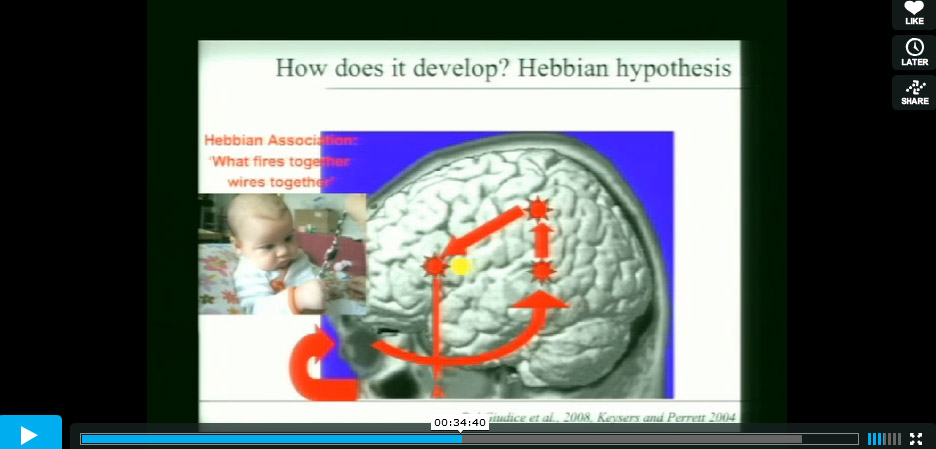
Hebb: how the brain learns to associate
How associations in the brain create mirror neurons
Linking your own actions with those of others
Learning the difference between self and other
You can only mirror what you can do
To babble is to build a mirror system for language
Associating my sensations with yours
Why parents imitate the facial expressions of their baby
Associating somatosensory and motor mirroring
The mirror system changes throughout life
Why mirror neurons cannot be everywhere in the brain
Learning to predict
Learning to complement
Hebbian learning makes shared circuits surprisingly simple
The Curious Incident–a literary introduction to autism
Autistic people have restricted interests
Autistic people neglect the social world
Are shared circuits impaired in autism?
Autistic people imitate less
Neuroimaging to quantify mirror system activity in autism
Autism is more complex than a broken mirror
Hebbian therapy could help in autism
Is a broken mirror a broken heart?
Birds of a feather flock together
The more you experienced the more you understand
The mirror system can lie: Implications for therapists
Look in your mirror and you will see a human
10. Unifying Theory of Social Cognition
It takes both thinking and intuition to understand others
I learn what you learn
Implications for teaching: punishment and reward in public
11. Empathic Ethics
Ethics has more to do with feelings than with thinking
Shared circuits are our moral voice
Animal Compassion
Moral Feelings and Learning
The evolutionary riddle: why do selfish genes care about
others?
Psychopathy —the dark side of morality
A checklist to identify psychopaths
Psychopaths are glib and grandiose liars
Sociopaths have an impulsive and parasitic lifestyle
Psychopaths have a history of antisocial behavior
Don’t empathize: think!
Knowing no fear
The dark art of silencing empathizing
A day out for Patient 13
Moral Shields
I shall do to you what I wish would be done to me
Laws exist because of cheaters and psychopaths
Epilogue - Are Mirror Neurons Good or Bad
How much of us is purely private, then? How many of
our bodily skills are ours? Shared circuits blur this question and
distinction because the moment I see you do something, your
actions become mine. The moment I see your pain, I share it. Are
these actions and pain yours? Are they mine? The border between
individuals is softened through the neural activity of these
systems. A little bit of you becomes me, and a little bit of me
becomes you.
October 05, 2012-
A Career for Two, With Empathy
Neuroscientists Christian Keysers and Valeria Gazzola have built their
careers on an idea that most of us accept but that is hard to pin down
scientifically: that subtle, often-unconscious cues and
perceptions—intuitions—offer insight into another person's feelings and
behavior. It's commonly called empathy
16 July 2012 - Psychopaths can feel empathy on demand
Psychopaths do not lack empathy and can turn it on when they want to,
according to new research that challenges the current understanding of
the psychological disorder. Psychopaths involved in the study showed
very little empathy for others, but this was reversed once they were
told the experiment would measure their levels of empathy.
“It was one of the really exciting and surprising
results,” said Christian Keysers from the Netherlands Institute for
Neuroscience, who announced these results at the Euroscience Open Forum
in Dublin, Ireland.
02:30 The nature of evil and psychopaths. In
Amsterdam, Christian Keysers is studying empathy. Christian is looking
for the source of human cruelty. To find out how empathy works in our
brains,Christian makes short films of painful acts to screen for test
subjects. He scans the brains of psychopaths. Psychopaths do have
capacity for empathy, they just don't use it spontaneously.
Observing another individual acting upon an object
triggers cerebral activity well beyond the visual cortex of the
observer in areas directly involved in planning and executing
actions. This we will call action simulation. Importantly, the brain
does not solely simulate the actions of others but also the
sensations they feel, and their emotional responses.
These simulation mechanisms are most active in individuals who
report being very empathic. Simulation may indeed be instrumental
for our understanding of the emotional and mental state of people in
our sight, and may contribute heavily to the social interactions
with our peers by providing a first-person perspective on their
inner feelings.
To investigate this trait, Keysers is
comparing 'normally' empathic people with those who lack empathy, such
as people with autism, and psychopaths. He suspects that psychopaths
may be able to recognize emotions in others but that they are also
able to disconnect that recognition from their own emotions. “Our
question is: do they do terrible things to other people because,
unlike most of us, they do not share the pain they inflict?” says
Keysers. His sophisticated trial design is intended to test whether
this is the case (
Kinesthetic Empathy 2010:
This multidisciplinary conference looked at the relationship between
the arts (dance in particular) and neuroscience. In his lecture
Christian explores how mirroring in the brain helps us understand why
we relate so strongly to movies and dance performances.
Understanding Virtue 2011:
At this Caltech conference, researchers from various fields came
together to explore what makes humans virtuous. Christian explained
how the discovery of mirror neurons sheds light onto our morality:
"Dr. Christian Keysers gives a lecture entitled, "The Vicarious Brain:
The Neural Basis of Empathy, Learning by Observation, and Sociopathy."
Dr. Keysers is Professor for the Social Brain at the University of
Groningen.
This session is part of the conference, Understanding Virtue: New
Directions Bridging Neuroscience and Philosophy, funded by a grant
from the Science and Transcendence Advanced Research Series (STARS) of
the Center for Theology and Natural Sciences. It was sponsored by the
Travis Research Institute at Fuller Theological Seminary and the
California Institute of Technology."
11:00 Looking at Virture
evolution stories says- survival of the fittest and
selfish gene
Dr. Nancey Murphy responds to Christian Keyser's lecture, "The
Vicarious Brian: The Neural Basis of Empathy, Learning by Observation,
and Sociopathy" followed by a Question and Answer session with both
speakers. Dr. Murphy is Professor of Christian philosophy at Fuller
Theological Seminary.
The Empathic Brain
- detailed notes How the discovery of mirror neurons changes our understanding of human nature
(Worked at the lab where mirror neurons were discovered)
( Best way to build a culture of empathy? Marco Iacoboni said
educated people about mirror neurons)
(teaching empathy should start with mirror neurons)
Introduction: Connecting People
Wedding experience
James Bond and Spider
Mirror neurons and
seeing others eating chocolate
1 The Discovery of Mirror Neurons
Is perception like a sandwich?
From seeing to doing
Brain function based on connections between neurons
The brain vocabulary of action
Bringing visions into the world of movement
How the brain encodes goals
What happens when we hear an action?
2 The Power of Intuition
rational scientists create description of brain
mirror
neurons,how us that abstract thinking is not the only process we use while
observing the behavior of other organisms
We predict the actions of others based on what we would do
Understanding others: What it would feel like to do the same
reading
intensions (motivations)
How mirror neurons facilitate imitation
3 Human Mirroring
Seeing an action activates our body
Magnetizing the mirror system
From Parma to Holland: A day in the new lab
We understand action sounds through our own actions
The mirror system includes several brain regions
Empathic individuals mirror more
4 Born to Socialize
Learning how to perform an action changes our perception
piano
players study
study
with Ballet dancers
fencing courses
If
you truly want to understand particular actions of other individuals, don’t
just study, but acquire their skills, and you will understand them much
better. Referees in sports, musical critics, sports’ therapists, and many
other professionals should all benefit from realizing that there is a tight
causal relationship between their motor skills and their perception.
The mirror in our brain even responds to robots
How people born without hands mirror hand movements
Mirror system facilitates understanding of goals
Learning by observation
A neural basis for intuitions
Implications for teaching: an action is worth a thousand
words
In
our knowledge-based civilization, abstract knowledge is valued higher than
any practical skill. Einstein, able to grasp the hidden laws of matter and
the universe through a simple equation, E=mc2, represents the ultimate
genius that most people would be proud to be. Intellectual, abstract,
rational thinking is often seen as the goal that schools should strive
toward, with more practical and intuitive skills seen as less
worthwhile.
In
terms of teaching, the mirror system suggests that abstract theory might
not always be the most effective way of teaching
Simulation is a fundamental principle of brain function
Another prominent example of simulation is imagination.
Imagining actions, viewing actions, and hearing the sound of actions can
thus all be seen as examples of simulation.
so
what is cognitive empathy???
5 Language
The blue banana with a hundred legs
Searching for language’s missing link
A scenario for the evolution of language
Linking the motor system with language
Bridging the inexplicable gap to language
Foundation #1: Realizing that a message came through
Mirror neurons could play a particular role in establishing this sense of
“getting a message through” even in our non-human ancestors.
Foundation # 2: Hearing is doing
Foundation #3: Associating meaning and words
Canonical neurons
Foundation #4: The grammar of actions
Conclusion
6 Sharing Emotions
Models of emotional communications
Emotional contagion and facial mimicry
direct facial mimicry
direct emotional contagion
Sharing the feeling of disgust
From mirror neurons to shared circuits
Recognizing emotion in others
Recognizing emotional sounds
You need to feel emotions to empathize with others
Connecting what you see with what you feel
The body is part and parcel of the mind
More empathic people activate the insula more strongly
Delight is also shared in the insula
The power of words
It takes one to know one
The difference between a fake and a real smile
Sharing facial expressions is essential for understanding
others’ emotions
Facial mimicry triggers emotional contagion
Sharing emotions with a poker-face
Blurring the border between individual
7 Sensations
Seeing touch is literally touching
Why it hurts to damage your car
How your pain becomes my pain
Is knowing as good as seeing?
Why being touched feels different from viewing touch
Men reserve their empathy for fair people, women don’t
Starting a war requires down-regulating empathy
The social brains of women and men may differ
I can feel you move
8 Learning to Share
Hebb: how the brain learns to associate
How associations in the brain create mirror neurons
Linking your own actions with those of others
Learning the difference between self and other
You can only mirror what you can do
To babble is to build a mirror system for language
Associating my sensations with yours
Why parents imitate the facial expressions of their baby
Associating somatosensory and motor mirroring
The mirror system changes throughout life
Why mirror neurons cannot be everywhere in the brain
Learning to predict
Learning to complement
Hebbian learning makes shared circuits surprisingly simple
9 Autism and Misunderstandings
The Curious Incident–a literary introduction to autism
Autistic people have restricted interests
Autistic people neglect the social world
Are shared circuits impaired in autism?
Autistic people imitate less
Neuroimaging to quantify mirror system activity in autism
Autism is more complex than a broken mirror
Hebbian therapy could help in autism
Is a broken mirror a broken heart?
Birds of a feather flock together
The more you experienced the more you understand
The mirror system can lie: Implications for therapists
Look in your mirror and you will see a human
10 Unifying Theory of Social Cognition
It takes both thinking and intuition to understand others
I learn what you learn
Implications for teaching: punishment and reward in public
11 Empathic Ethics
Ethics has more to do with feelings than with thinking
Shared circuits are our moral voice
Animal Compassion
Moral Feelings and Learning
The evolutionary riddle: why do selfish genes care about
others?
Psychopathy —the dark side of morality
A checklist to identify psychopaths
Psychopaths are glib and grandiose liars
Sociopaths have an impulsive and parasitic lifestyle